
Gumloop vs MindStudio: Governed Team Agents or Deployable Model Hub (2026)
Verified Oct 1, 2026 by Tooliverse Editorial
Gumloop and MindStudio are no-code platforms for building AI agents on a visual canvas. Gumloop emphasizes team-shared agents with spend controls, while MindStudio emphasizes at-cost model access and exporting agents in several deployment formats.
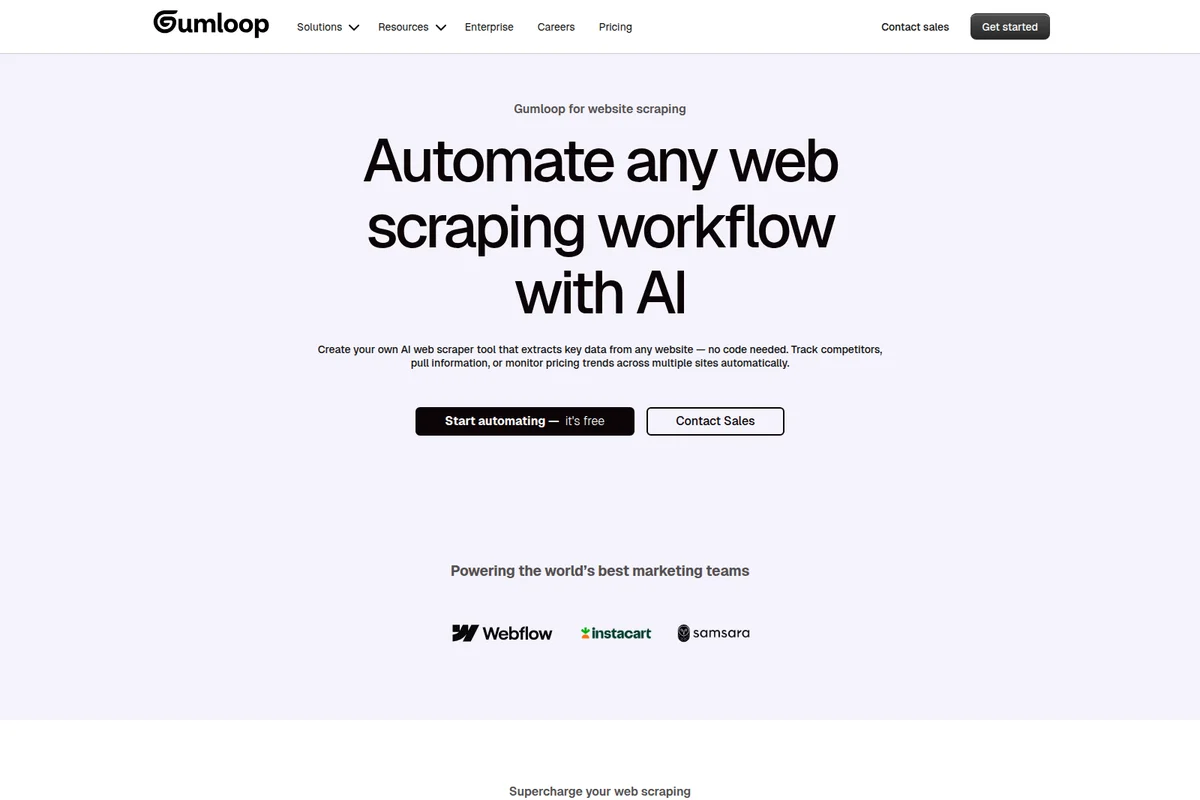
Gumloop landing page hero section showcasing the core value proposition of automating web scraping with AI, presented with a clean minimalist interface.

 MindStudio
Mindstudio output samples showing two applications: an 'Elite Running Mechanics' article and an interactive 'Mortgage Calculator' application.

Gumloop AI automation platform homepage showcasing a visual workflow builder and AI integration features with a modern, vibrant UI.
 MindStudio
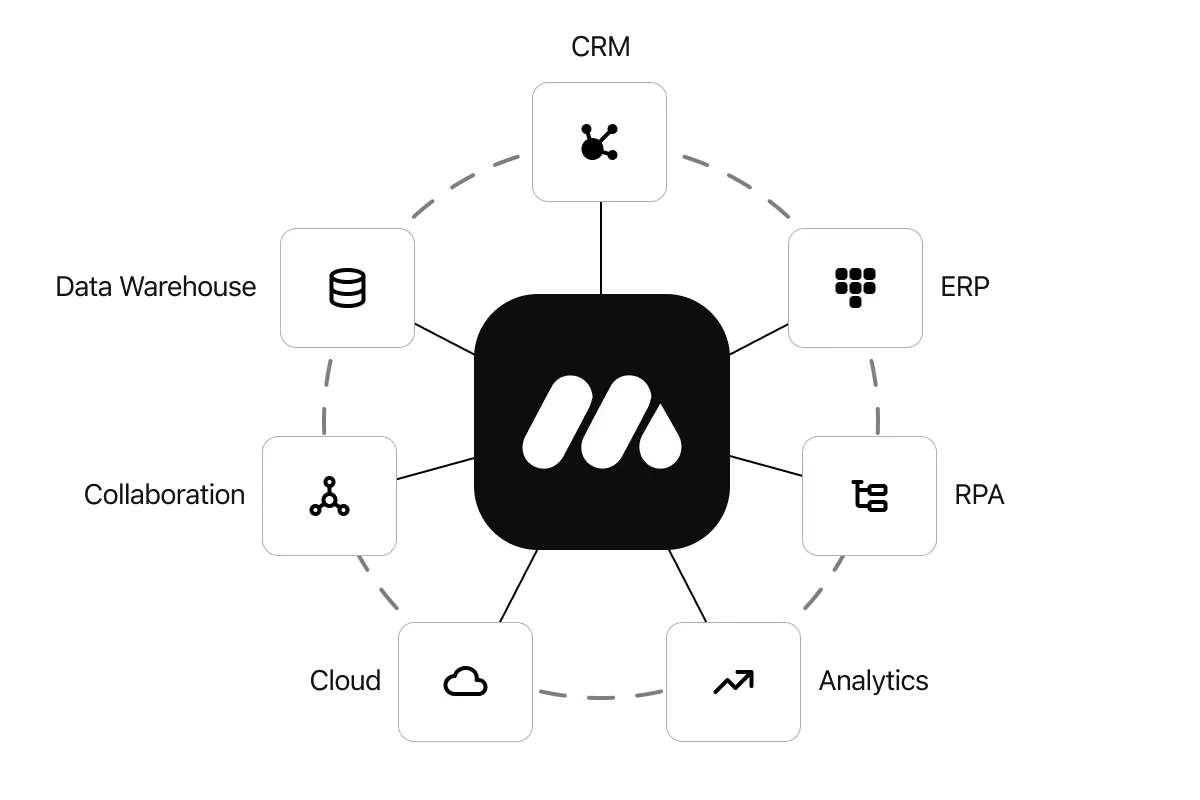
Mindstudio feature deep-dive showing its integration ecosystem with CRM, ERP, RPA, Analytics, Cloud, Collaboration, and Data Warehouse using a dark-mode iconic diagram.
Gumloop vs MindStudio Review: Tooliverse Consensus



Based on 134 verified reviews across 6 platforms,
combined with Tooliverse's expert analysis
Both tools build no-code AI agents on a visual canvas, and both carry a learning curve. MindStudio scores 9.27/10 from 59 reviews, praised for at-cost access to 200+ models, mid-workflow model swapping, and deployment as web apps, Chrome extensions, or MCP servers. Gumloop scores 8.46/10 from 75 reviews, with strengths in the Gummie assistant, web scraping, and fast support, though credits get expensive at volume and its integration library trails Make and Zapier. MindStudio limits control over deployed app styling; Gumloop leans toward team governance.
Bottom line: Choose MindStudio for deploying agents in varied formats with at-cost model access and a free tier to start; choose Gumloop for team-shared agents with spend controls, governance, and strong web scraping.
Where Each Tool Wins
Strengths unique to each tool (what both do well is covered further down)
- •Features a powerful "Gummie" assistant that builds and debugs automation flows via natural languagementioned in 58 reviews
- •Delivers robust web scraping capabilities that handle dynamic content for automated researchmentioned in 47 reviews
- •Offers exceptionally fast customer support and rapid shipping of user-requested featuresmentioned in 41 reviews
MindStudio- •Provides seamless access to 200+ models from OpenAI, Anthropic, and Google at-costmentioned in 42 reviews
- •Offers versatile deployment formats including web apps, Chrome extensions, and MCP serversmentioned in 31 reviews
- •Simplifies RAG implementation by allowing direct uploads of PDFs, CSVs, and Docx filesmentioned in 27 reviews
Each Tool’s Watch-Outs
Drawbacks unique to each tool
- •Credit-based pricing model can become expensive for high-volume, AI-intensive automation tasksmentioned in 32 reviews
- •Integration library is currently smaller than established competitors like Make or Zapiermentioned in 27 reviews
- •Documentation for advanced custom functions and complex logic gates is still being developedmentioned in 22 reviews
MindStudio- •Offers limited flexibility for customizing the visual UI and branding of deployed applicationsmentioned in 12 reviews
- •Free tier is restrictive with a 1,000-run cap and single agent limitmentioned in 9 reviews
- •Users report occasional stability concerns within the editor during complex workflow buildsmentioned in 7 reviews
Which Tool Is Best for Your Use Case?
| Use case | MindStudio | |
|---|---|---|
Team governance and spend control Gumloop offers spend caps and approvals by agent, team, or org plus audit logging and RBAC, while MindStudio's per-user budgets and audit logs sit in Governance and Usage Controls and the Business tier. | Excellent | Strong |
Low-cost solo start MindStudio has a Free tier and a $20/month Individual plan, whereas Gumloop's only self-serve tier is Pro at $37/month. | Fair | Excellent |
Flexible agent deployment MindStudio exports agents as web apps, Chrome extensions, webhook/API endpoints, and MCP servers (31 mentions), while Gumloop focuses on triggers, Slack, Teams, and Gmail. | Strong | Excellent |
Web research automation Gumloop's web scraping that handles dynamic content drew 47 mentions, and it can watch the web based on plain-English instructions. | Excellent | Strong |
Integration breadth MindStudio lists 1,000+ pre-built integrations, while Gumloop lists 300+ connectors and reviewers note its library is smaller than Make or Zapier. | Strong | Excellent |

One tool ships agents; the other runs them like a team. The 32 Gumloop reviewers warning about credits and the 15 MindStudio reviewers calling billing confusing agree: budget for usage first. If you're shipping solo as web apps or Chrome extensions, start free on MindStudio and move to $20/month once anything goes live; if a team needs shared agents with spend caps and approvals, test Gumloop Pro at $37/month during its 14-day trial.
Gumloop vs MindStudio Pricing 2026
Gumloop starts at $37/month on Pro, while MindStudio starts at $20/month on Individual after a free tier to trial it. Over a full year that is roughly $444 for Gumloop versus $192 for MindStudio with annual billing.
Pro
- Unlimited agents, seats, and teams
- 35+ models
- 20k included credits per month
- 8% orchestration fee
- 14-day free trial
MindStudioIndividual
- Unlimited agents
- Unlimited runs / month
- Premium AI image & video models
- Bring your own API keys
- Slack community and live weekly workshops
The Costs the Pricing Pages Don't Mention
- Gumloop credits and orchestration fee
- Pro at $37/month includes 20k credits per month and an 8% orchestration fee. AI-heavy, high-volume workflows can burn through allowances quickly (32 mentions).
- MindStudio model usage billing
- Model usage is billed separately from the subscription on every plan, and high-volume agents are where the real bill appears (15 mentions).
- MindStudio Free tier caps
- The Free tier is limited to one agent and 1,000 runs per month, so anything live needs the $20/month Individual plan.
- Enterprise-only features
- Gumloop's VPC deployment and org-wide connector policies sit in the custom-priced Enterprise tier, and MindStudio's SSO and self-hosting sit in the custom-priced Business tier.
Gumloop vs MindStudio: Feature Comparison
As advertised on each tool's own site — "not advertised" doesn't necessarily mean missing.
| Feature | MindStudio | |
|---|---|---|
| Both tools | ||
| No-code agent building from plain language | ✓ | ✓ |
| Multi-model access and routing | ✓ | ✓ |
| Integrations and connectors | ✓ | ✓ |
| Triggers and deployment modes | ✓ | ✓ |
| Spend and usage controls | ✓ | ✓ |
| Permissions and audit trails | ✓ | ✓ |
| Approvals and human oversight | ✓ | ✓ |
| Testing and evaluation | ✓ | ✓ |
| Developer extensibility | ✓ | ✓ |
| Generated apps and outputs | ✓ | ✓ |
| Highlighted by Gumloop | ||
| Private cloud deployment | ✓ | not advertised |
| Work inside chat and email tools | ✓ | not advertised |
| Highlighted by MindStudio | ||
| Spec-to-app product agent | not advertised | ✓ |
| Training and community | not advertised | ✓ |
Gumloop vs MindStudio: User Reviews
Selected to show the range — the strongest praise and the most useful criticism for each.
MindStudio"I love how Gumloop is extremely easy to use and it's extremely fun working on it. I can go from idea to a working solution with just prompts, without needing to be a coder or engineer."
MindStudio"MindStudio feels more practical to me in this space since it makes more sense for packaging a real agent workflow than chasing the whole parallel agents vision."
"Comparing to traditional low code automation platforms, there is a ton more customization here where you can solve much larger problems. This is really important for the LLM paradigm."
MindStudio"I use MindStudio to create agents easily, and the debugger helps a lot in figuring out what's not working. It's much faster than coding from scratch."
"Building complex automated workflows requires learning. The credit system can get expensive fast with AI-intensive workflows compared to self-hosting or simpler tools."
MindStudio"Excellent for beginners and simple workflows but limits complex projects and risks platform lock-in. I wish there were more export options for the logic itself."
Gumloop vs MindStudio: Frequently Asked Questions (FAQs)
Which is cheaper, Gumloop or MindStudio?
MindStudio has a Free tier and a $20/month Individual plan, so it is meaningfully cheaper to start. Gumloop's only self-serve tier is Pro at $37/month, with 20k included credits per month. Both add usage-based costs on top.
Does MindStudio have a free plan?
Yes. The Free tier allows one agent and 1,000 runs per month, and includes the 200+ model Service Router. Reviewers call it restrictive for anything beyond testing an idea.
Which tool supports more AI models?
MindStudio advertises 200+ models at cost with no markup, and supports bring-your-own keys. Gumloop offers 35+ models, with an Auto mode that picks a model per task and no individual API key management.
Which is easier to learn?
Neither is effortless. Gumloop's steep learning curve around node logic and variable passing drew 38 mentions, while MindStudio's time investment for advanced logic drew 18. Both offer AI assistants (Gummie and Agent Architect) to help you start.
Can I deploy agents outside the platform?
MindStudio is stronger here, with web apps, browser extensions, email-triggered agents, webhook/API endpoints, and MCP servers. Gumloop agents run on triggers and schedules and can be used through Slack, Microsoft Teams, and Gmail.
Which is better for enterprise security needs?
Gumloop advertises VPC deployment in AWS, Azure, or Google Cloud, plus app policies and MCP governance. MindStudio's Business tier lists SSO, audit logs, budgets, and self-hosting.
How this comparison works
Consensus Scores aggregate verified reviews from 8 platforms — Reddit, Product Hunt, G2, Capterra, app stores and more — weighted by source reliability.
Features and pricing come from each tool's official site, last verified Oct 1, 2026. Verdicts are computed from this data.
The Editor's Note is our experts' read of what the data means for your decision — and comparison placement is never for sale. Editorial Policy
Best Gumloop & MindStudio Alternatives

Relevance AI
Put a governed AI workforce to work and drive ROI in weeks, not quarters.

Relay.app
Automate work with AI, apps, and human-in-the-loop steps—no code required.
Dify
Build, deploy, and scale production-ready AI agents and workflows without rebuilding your stack.

Lindy
An AI teammate that does the real work across your tools, so your whole team gets time back.
Langflow
Build and deploy AI agents visually, then ship them as APIs or MCP servers without boilerplate.