
Iris.ai Review 2026 - Enterprise AI Data Foundation
Verified Sep 16, 2026 by Tooliverse Editorial
Iris.ai transforms messy PDFs, patents, and reports into AI-ready knowledge—90% of enterprise data sits unstructured and unused. ArcelorMittal cut patent review time by 90% using its Axion™ engine.
Iris.ai Researcher Workspace - Your Dashboard
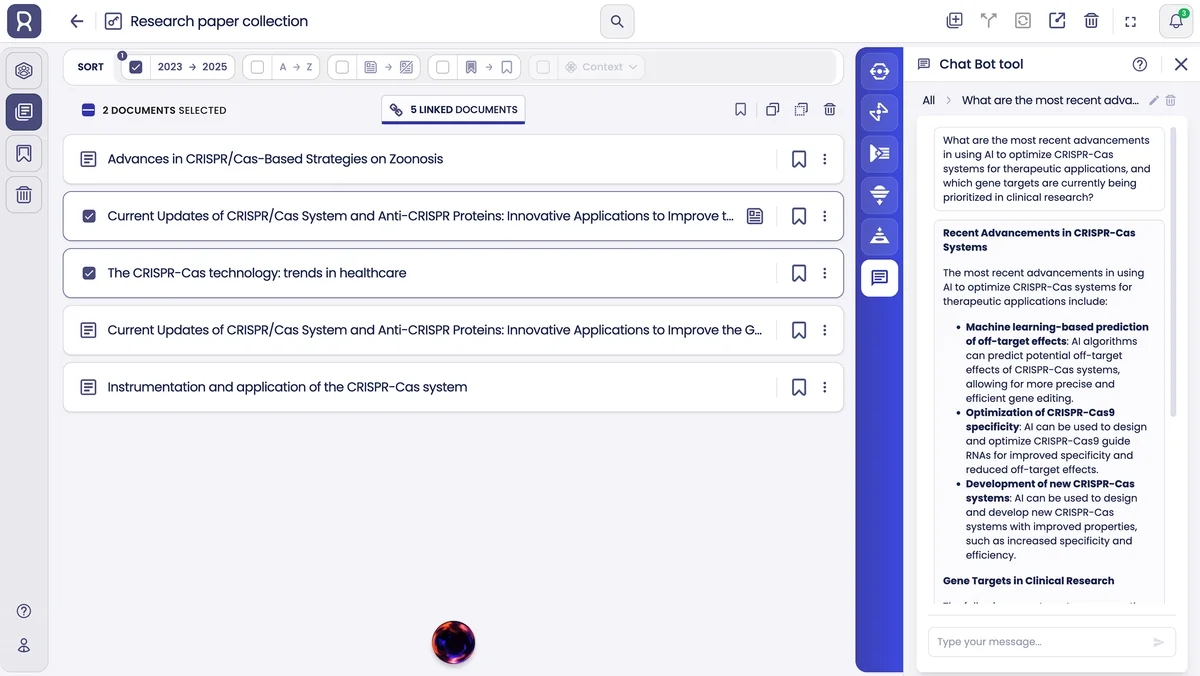
Organize research papers and get AI-powered insights from your collection.
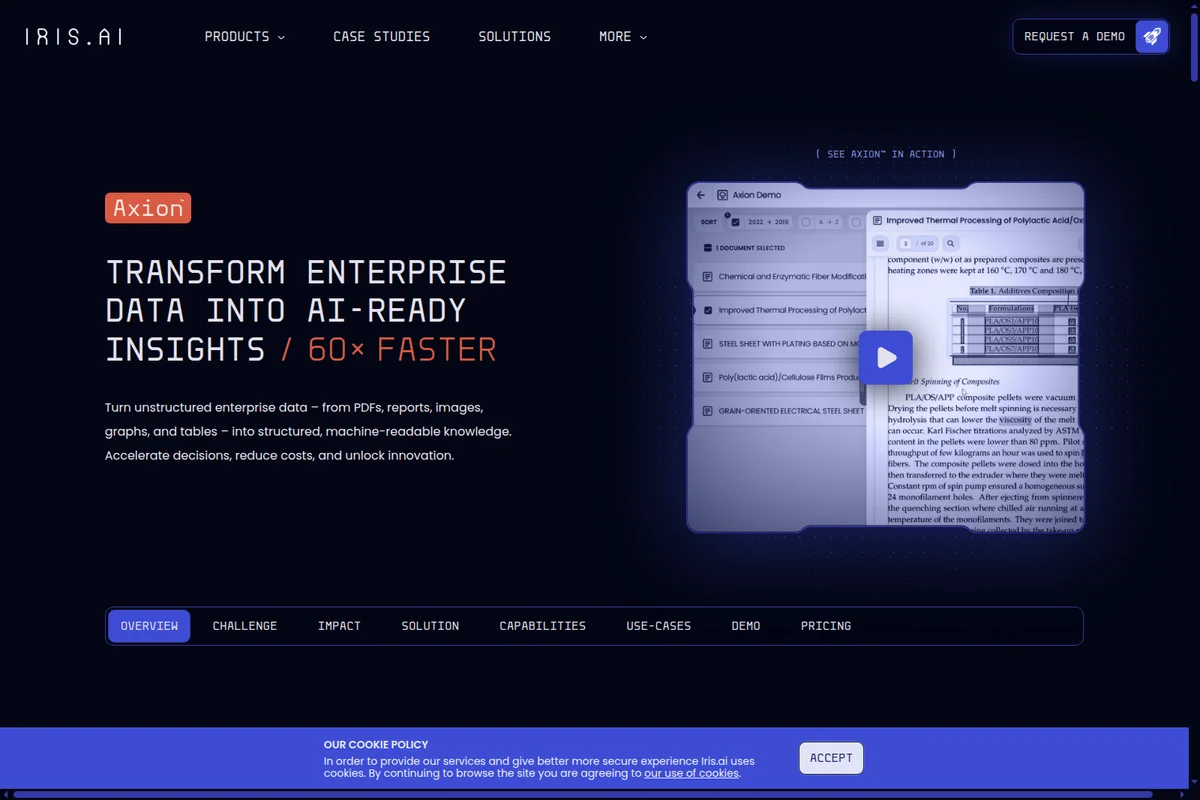
Transform unstructured enterprise data into AI-ready insights 60x faster.
Accelerate RAG AI workflow development and deployment with Agentic in a single platform.
Iris.ai Review: Tooliverse Consensus





Based on 280 verified reviews across 5 platforms,
combined with Tooliverse's expert analysis
Iris.ai turns scientific literature into a navigable visual map instead of a keyword-matched list, letting researchers spot connections and gaps that standard search tools miss entirely. Reviewers consistently praise its contextual search and automated data extraction for cutting weeks off systematic reviews and patent monitoring. The tradeoff shows up in accessibility: advanced tools like Atlas demand a real learning curve, and institutional pricing puts serious functionality out of reach for individual researchers working without institutional backing.
Bottom line: An effective research intelligence platform that turns literature review into visual discovery, though its steep learning curve and institution-first pricing leave individual researchers wanting more.
Iris.ai | Key Specs
- Platforms
- Web (API, on-premise, or cloud deployment)
- Pricing Model
- Custom/Contact Sales (Starter, Professional, Enterprise tiers) See plans
- Privacy/Data Use
- No training on client data, data always remains with client
- Security
- ISO 27001, GDPR compliant, role-based access control, full audit logging See details
Wins
- •Accelerates literature mapping and discovery for complex research projectsmentioned in 84 reviews
- •Provides a visual knowledge map that helps identify research gaps effectivelymentioned in 72 reviews
- •Automates the extraction of key data points from thousands of papers simultaneouslymentioned in 65 reviews
Watch-Outs
- •Steep learning curve for the advanced "Atlas" and "Researcher" toolsmentioned in 42 reviews
- •Pricing structure is geared toward institutions, making it expensive for individual researchersmentioned in 38 reviews
- •Occasional difficulty in processing very niche or highly technical PDF formatsmentioned in 31 reviews
Iris.ai Features 2026
Unified Data Access Layer
Connects to PDFs, databases, cloud apps, and scanned files in one interface, unifying fragmented enterprise data sources.
Automated Contextual Chunking & Indexing
Breaks documents into retrievable segments enriched with metadata to improve retrieval accuracy for AI systems.
Industry-Specific Schema Templates
Prebuilt data structures for legal contracts, patents, clinical trials, financial statements, and more, avoiding schema reinvention.
Seamless LLM & RAG Integration
Structured output is ready for AI agents, RAG pipelines, and decision-support systems without extra prep work.
Iris.ai User Reviews
Selected Reviews
"Iris.ai has completely changed how I approach my literature reviews. The visual mapping tool allows me to see connections between papers that I would have missed using just Google Scholar or PubMed."
"Our R&D department uses Iris.ai to monitor new patents and publications. It has significantly reduced the manual labor involved in our weekly landscape reports."
"Powerful tool but the UI is quite dense. I spent several hours just trying to figure out how to filter the results properly. It's definitely built for power users, not casual searching."
More from the Community
"The Atlas feature is a lifesaver for my PhD. It's not perfect at extracting every single data point, but it gets me 80% of the way there in a fraction of the time."
"Finally, an AI that actually understands scientific context instead of just hallucinating facts. The precision in the search results is impressive."
"The browser extension is handy for grabbing papers on the fly, though it sometimes fails to parse the metadata correctly on certain publisher sites."
"I love the concept, but the individual subscription price is just too high for a student. I'm stuck using the limited free version which is frustrating."
"The customer support is excellent and they really listen to feedback. They've improved the PDF processing significantly over the last few months."
"If you are doing a systematic review, this is the gold standard. The ability to export structured data directly into Excel is a massive time-saver."
"Great for discovering 'adjacent' research that doesn't share the same keywords but covers the same concepts. Very helpful for interdisciplinary work."
"It's a bit slow when processing large folders of PDFs. I wish the background processing was more efficient so I didn't have to keep the tab open."
"The most sophisticated AI research assistant I've used. It actually helps you understand the 'why' behind the search results."
Iris.ai Pricing 2026
View SourceAxion's Starter tier handles a one-time extraction of up to 10 documents, useful for testing the waters but too limited for ongoing research work. Professional, covering roughly 100,000 pages and 2 million credits, is where serious literature reviews and systematic analyses actually happen. Both require requesting a custom quote rather than instant checkout, so budget time for a sales conversation before you can start extracting data.
Iris.ai In-Depth Review 2026

Iris.ai is a research intelligence platform for literature review, patent monitoring, and systematic analysis, built around tools called Atlas, Researcher, and a contextual search engine that reads for meaning instead of matching words. It runs as a web platform with a browser extension for capturing papers on the fly. The pitch is straightforward: turn thousands of unstructured documents into a navigable map of a research field, then extract the specific data points that matter.
What It's Like Day-to-Day
The core workflow starts with a research question, and Iris.ai returns not just a ranked list but a visual map showing how papers relate to each other conceptually. This is where the tool earns its reputation: users consistently describe seeing connections between papers that traditional search never surfaced, and one G2 reviewer said it plainly, noting the tool "allows me to see connections between papers that I would have missed using just Google Scholar or PubMed.
Iris.ai Security & Compliance
Verified Compliance
- ISO 27001
- GDPR Compliant
Security Features
- Role-based access control
- Encryption
- Full audit logging
- On-premise / private cloud deployment
Privacy Commitments
- Data is never used to train general models and always remains with the client
- Research content, data, and inputs are not used for anything other than the client's own process
Iris.ai: Frequently Asked Questions (FAQs)
What is Axion™?
Axion is Iris.ai's AI-powered data extraction tool that connects to multiple data sources, processes diverse formats including PDFs, Word docs, and scanned images, and transforms them into structured, indexed data ready for search, analysis, and AI workflows.
How is Axion™ priced?
Axion™ offers three tiers: Starter (one-time extraction of up to 10 documents), Professional (up to ~100k pages with 2 million credits), and Enterprise (unlimited volume with up to 50% discount, as low as €0.05 per page). All tiers require requesting a demo for a custom quote.
What languages and formats does Axion™ support?
Axion supports 68+ languages (including Chinese) and processes PDFs (native & scanned), Word, Excel, PowerPoint files, plain text, HTML, images with text via OCR, graphs and charts, and data from connected platforms like SharePoint, Google Drive, and S3.
Can Axion™ handle non-text formats like images, graphs, and tables?
Yes, Axion extracts data from non-text formats including images, graphs, and tables. Its image captioning feature generates detailed descriptions for visuals, and advanced table/graph extraction retrieves values, labels, and relationships.
Iris.ai Integrations
| SharePoint | Google Drive | Amazon S3 |
| AWS |
Iris.ai: Verified Data Sheet
| # | Label | Data Point |
|---|---|---|
| [1] | Iris.ai Consensus: 7.90/10 | Iris.ai is a well-reviewed tool among AI research tools in the Tooliverse index, with a consensus score of 7.90/10 across 280 verified reviews. |
| [2] | What is Iris.ai | Iris.ai, founded in Norway in 2015, is an ISO 27001-certified AI Knowledge Foundation platform for regulated enterprises, structuring unstructured data via its Axion™ engine. It has ingested 330M+ documents and partners strategically with AWS, with pricing available via custom quote. |
| [3] | Tooliverse Consensus on Iris.ai | Iris.ai turns scientific literature into a navigable visual map instead of a keyword-matched list, letting researchers spot connections and gaps that standard search tools miss entirely. Reviewers consistently praise its contextual search and automated data extraction for cutting weeks off systematic reviews and patent monitoring. The tradeoff shows up in accessibility: advanced tools like Atlas demand a real learning curve, and institutional pricing puts serious functionality out of reach for individual researchers working without institutional backing. |
| [4] | Iris.ai Verdict | Iris.ai bottom line: An effective research intelligence platform that turns literature review into visual discovery, though its steep learning curve and institution-first pricing leave individual researchers wanting more. |
| [5] | Speeds up literature mapping | Iris.ai accelerates literature mapping and discovery for complex research projects, a strength cited across 84 user reviews. |
| [6] | Visual knowledge map surfaces research gaps | Iris.ai generates a visual knowledge map that helps researchers identify gaps in existing literature, a capability praised in 72 user reviews. |
| [7] | Automated data extraction at scale | Iris.ai automates extraction of key data points across thousands of papers simultaneously, a workflow improvement noted in 65 user reviews. |
| [8] | Contextual Search beats keyword matching | Iris.ai's Contextual Search understands scientific nuance beyond simple keyword matching, a feature highlighted in 58 user reviews. |
| [9] | Steep learning curve for Atlas/Researcher | Iris.ai's advanced Atlas and Researcher tools carry a steep learning curve, according to 42 user reports. |
| [10] | Costly for individual researchers | Iris.ai's pricing structure is geared toward institutional buyers, making it expensive for individual researchers, a concern raised in 38 user reviews. |
| [11] | Privacy: Data is never used to train general models and always remains with the client | Iris.ai privacy protections include Data is never used to train general models and always remains with the client and Research content, data, and inputs are not used for anything other than the client's own process. |
| [12] | Enterprise: Role-based access control | Iris.ai provides enterprise security with Role-based access control, Encryption, and Full audit logging. |
| [13] | Visual mapping surfaces missed connections | Iris.ai's visual mapping tool reveals connections between papers that researchers say they "would have missed using just Google Scholar or PubMed," according to a verified G2 reviewer. |
Best Iris.ai Alternatives
Hebbia
Staff AI on your next deal and turn firm knowledge into client-ready work.
Petal
Chat with your documents and get fully sourced, trustworthy answers from the knowledge you already own.
Elicit
Understand what science already knows, so you can discover the unknown, with evidence you can trace.