
Mastra Review 2026 - TypeScript Agent Framework
Verified Oct 2, 2026 by Tooliverse Editorial
Mastra gives TypeScript developers agents, workflows, memory, and observability in one open-source framework. Prototype in a local Studio at localhost:4111, then ship the same code to production. Over 28.5k GitHub stars back it.
How to Monitor and Debug Mastra Agents in Production
Deploy a Mastra AI Agent to AWS in Minutes with Defang
Generate complex SQL queries instantly from simple English questions.
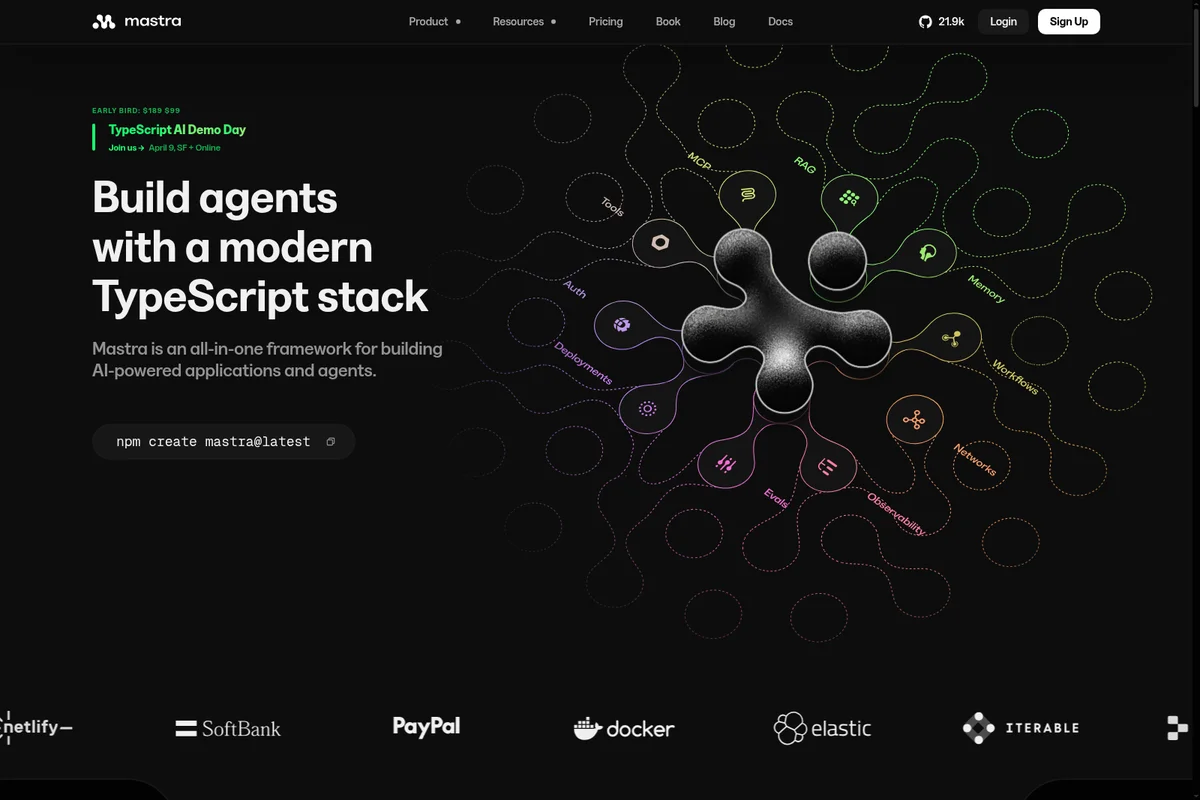
Build AI-powered applications and agents with a modern TypeScript framework.
Streamline data analysis and forecasting with AI-powered insights.
Visualize and build your automated workflows step-by-step.
Mastra Review: Tooliverse Consensus




Based on 120 verified reviews across 4 platforms,
combined with Tooliverse's expert analysis
Mastra is a TypeScript-native agent framework that keeps its surface area small: agents, graph-based workflows, memory and tracing arrive in one package, and a local dev server makes debugging agent loops quick. Reviewers praise the typed APIs, the unified model interface and telemetry that shows where a multi-step run stalled. The tradeoffs are a younger plugin ecosystem than LangChain's, a learning curve for anyone new to agentic patterns, and documentation that sometimes trails fast releases. Teams comfortable in TypeScript get the most from it.
Bottom line: One of the strongest TypeScript agent frameworks, pairing typed workflows and local-first debugging with solid observability, though its young plugin ecosystem and agentic learning curve mean newcomers will do some digging.
Mastra | Key Specs
- Platforms
- Web (Studio), API/SDK, self-hosted Node.js
- Pricing Model
- Free open source + Platform Free/Teams ($0-250/mo) + usage-based See plans
- Privacy/Data Use
- Enterprise data stays in your VPC; Apache 2.0 self-hosting
- Security
- SOC 2 docs (Teams), SSO, RBAC, audit logs (Enterprise) See details
Wins
- •Simplifies complex agentic workflows with a clean TypeScript-first approachmentioned in 45 reviews
- •Provides excellent local-first development capabilities for faster iterationmentioned in 38 reviews
- •Integrates seamlessly with popular LLM providers via a unified interfacementioned in 32 reviews
Watch-Outs
- •Newer ecosystem means fewer community-built plugins compared to LangChainmentioned in 22 reviews
- •Steep learning curve for developers not familiar with agentic patternsmentioned in 18 reviews
- •Documentation can occasionally lag behind the rapid pace of updatesmentioned in 15 reviews
Mastra Features 2026
Agents
Typed agents with instructions, models, tools, memory and runtime behavior; includes tool calling, MCP, logging, tracing and eval primitives.
Graph-Based Workflows
Orchestrate multi-step processes with sequential steps, parallel branches, conditional logic and loops, plus durable state.
Human-in-the-Loop & Time Travel
Any workflow step can suspend for human input and resume later; rewind to any step with original context to debug or replay.
Observational Memory
Durable context via observational memory, semantic recall and thread-aware storage that learns about users automatically.
Mastra User Reviews
Selected Reviews
"Finally a framework that doesn't feel like it's fighting me. The local-first approach with the dev server is a game changer for debugging agent loops."
"Mastra has completely changed how I build agents. The TypeScript types are actually helpful, unlike some other frameworks where everything is "any"."
"Solid architecture. It's much leaner than LangChain. I appreciate the focus on observability from day one, though I'd like to see more vector store integrations."
More from the Community
"The core logic is great, but I found the documentation for custom tools a bit confusing. Had to dig into the source code to figure out the schema requirements."
"The telemetry features are top-notch. Being able to see exactly where an agent stalled in a multi-step process saves hours of logging."
"Really enjoying the DX. It feels like it was built by people who actually write TS for a living. Some of the error messages could be more descriptive though."

"Just ported my project to Mastra.ai and deleted 300 lines of boilerplate. The agentic workflow abstraction is just right."
"The core logic is great, but I found the documentation for custom tools a bit confusing. Had to dig into the source code to figure out the schema requirements."
"The telemetry features are top-notch. Being able to see exactly where an agent stalled in a multi-step process saves hours of logging."
"Really enjoying the DX. It feels like it was built by people who actually write TS for a living. Some of the error messages could be more descriptive though."
"Just ported my project to Mastra.ai and deleted 300 lines of boilerplate. The agentic workflow abstraction is just right."
"It's a promising start. However, the ecosystem is still small. If you need a specific niche integration, you're likely writing it yourself for now."
"Best agent framework for TS developers. The way it handles state and memory is much more intuitive than the graph-based approaches I've tried."
"Great tool for rapid prototyping. I was able to get a RAG agent running in under 10 minutes. Looking forward to more deployment templates."
"It's a promising start. However, the ecosystem is still small. If you need a specific niche integration, you're likely writing it yourself for now."
"Best agent framework for TS developers. The way it handles state and memory is much more intuitive than the graph-based approaches I've tried."
"Great tool for rapid prototyping. I was able to get a RAG agent running in under 10 minutes. Looking forward to more deployment templates."
Mastra Pricing 2026
View SourceStart on Starter at $0: 100K observability events and 24 CPU hours cover a prototype or internal pilot, and the Apache 2.0 framework itself costs nothing to self-host. Teams at $250/month is the tier for production work, adding 1M events, six months of retention, SSO and SOC 2 documentation. Watch the metered overages on events, CPU time and gateway tokens, since those are what actually move the bill.
Mastra In-Depth Review 2026

Mastra is an open-source TypeScript framework, released under Apache 2.0 by the team behind Gatsby, that bundles agents, graph-based workflows, memory, evals and observability in one package. It connects to more than 90 model providers through one interface, plugs into React, Next.js and Node apps or runs as a standalone server, and has gathered about 28.5k GitHub stars. A paid Platform layer adds hosted observability and deployment for teams that want it.
What It's Like Day-to-Day
Reviewers describe a workflow that starts on the local machine. Mastra Studio runs at localhost:4111, where developers chat with an agent, inspect traces and refine prompts before anything ships, and one Reddit user called the local dev server "a game changer for debugging agent loops." Workflows read as plain .then(), .branch() and .parallel() calls, and any step can suspend for human input and resume later, with state held in storage so a paused run can wait as long as it needs to.
Typing is the other recurring theme.
Mastra Security & Compliance
Verified Compliance
- SOC 2 documentation available (Teams plan)
Security Features
- SSO (Teams and Enterprise)
- RBAC and audit logs (Enterprise)
- Guardrails against prompt injection and data leaks
Privacy Commitments
- Self-hosted Enterprise: data stays in your VPC; no traces, prompts, or outputs leave your environment
- Apache 2.0 open source lets you control your source code and infrastructure
Mastra: Frequently Asked Questions (FAQs)
Is Mastra free and open source?
Yes, Mastra's core framework is open source under the Apache 2.0 license and is free to start with no seats or usage tiers. Enterprise features are source-available under the Mastra Enterprise License.
How much does Mastra Platform cost?
Mastra Platform has a free Starter plan at $0/month, a Teams plan at $250/month, and custom-priced Enterprise. Starter includes 100K observability events, 24 CPU hours and 15 days of retention; Teams includes 1M events, 250 CPU hours and 6 months of retention.
What is Mastra?
Mastra is an open-source TypeScript framework for building AI-powered applications and agents. It provides agents, workflows, memory, workspaces and observability, and integrates with React, Next.js and Node or deploys as a standalone server.
What AI models and providers does Mastra support?
Mastra's model router connects to 90+ providers through one interface, including OpenAI, Anthropic and Google. Other pages cite 600+ and 1,000+ models; set a provider API key as an environment variable and Mastra auto-detects it.
Mastra Integrations
| OpenAI | Anthropic | Google Gemini |
| xAI | React | Next.js |
| Astro | SvelteKit | Express |
| Hono | Fastify | Vercel |
| Netlify | Cloudflare | Bun |
| Deno | Jira | GitLab |
| incident.io | Slack | Microsoft Teams |
| LibSQL | PostgreSQL |
Mastra: Verified Data Sheet
| # | Label | Data Point |
|---|---|---|
| [1] | Mastra Consensus: 9.29/10 | Mastra is one of the highest-rated AI agent tools in the Tooliverse index, with a consensus score of 9.29/10 across 120 verified reviews. |
| [2] | What is Mastra | Mastra is an open-source (Apache 2.0) TypeScript agent framework from the team behind Gatsby, with agents, workflows, memory and observability. It has 28.5k GitHub stars; the platform starts free, with Teams at $250/month. |
| [3] | Tooliverse Consensus on Mastra | Mastra is a TypeScript-native agent framework that keeps its surface area small: agents, graph-based workflows, memory and tracing arrive in one package, and a local dev server makes debugging agent loops quick. Reviewers praise the typed APIs, the unified model interface and telemetry that shows where a multi-step run stalled. The tradeoffs are a younger plugin ecosystem than LangChain's, a learning curve for anyone new to agentic patterns, and documentation that sometimes trails fast releases. Teams comfortable in TypeScript get the most from it. |
| [4] | Mastra Verdict | Mastra bottom line: One of the strongest TypeScript agent frameworks, pairing typed workflows and local-first debugging with solid observability, though its young plugin ecosystem and agentic learning curve mean newcomers will do some digging. |
| [5] | Open Source (Self-Hosted Free): Free | Mastra offers a free Open Source (Self-Hosted Free) tier that is Apache 2.0 licensed, letting teams build and host agents anywhere at no cost. |
| [6] | Unified router for 90+ LLM providers | Mastra connects to popular LLM providers through one model router interface, a strength noted in 32 user reviews; the router covers 90+ providers including OpenAI, Anthropic and Google, with some pages citing 600+ and 1,000+ models across those providers. |
| [7] | Built-in tracing, scorers and observability | Mastra ships with telemetry and observability tools out of the box, praised in 28 user reviews, including built-in scorers (LLM-as-Judge or code-based), traces of agent calls and token usage, and guardrails against prompt injection. |
| [8] | Documentation eases getting started | Mastra's documentation is credited with making onboarding straightforward in 25 user reviews, with guides covering Next.js, React, Astro, Express, SvelteKit and Hono for adding it to an existing project or starting a new one. |
| [9] | Platform Teams: $250/month | Mastra Platform Teams costs $250 monthly and adds 1M observability events, then $8/100K, significantly expanding on the free tier's capabilities. |
| [10] | Clean TypeScript-first agent workflows | Mastra simplifies complex agentic workflows with a TypeScript-first design, a strength cited in 45 user reviews, where typed agents and graph-based workflows built with .then(), .branch() and .parallel() replace hand-wired orchestration code. |
| [11] | Smaller plugin ecosystem than LangChain | Mastra's newer ecosystem offers fewer community-built plugins than LangChain, according to 22 user reports, so developers needing niche integrations may have to write them themselves. |
| [12] | Steep learning curve for agentic newcomers | Mastra presents a steep learning curve for developers unfamiliar with agentic patterns, according to 18 user reports, since agents, workflows, memory and evals are all new concepts to newcomers. |
| [13] | SOC 2 documentation available (Teams plan) | Mastra lists SOC 2 documentation available (Teams plan) among its security certifications. |
| [14] | Enterprise: SSO (Teams and Enterprise) | Mastra provides enterprise security with SSO (Teams and Enterprise), RBAC and audit logs (Enterprise), and Guardrails against prompt injection and data leaks. |
| [15] | Useful TypeScript types, changed how I build agents | Mastra has "completely changed how I build agents," according to a verified Product Hunt reviewer, who added that its TypeScript types are actually helpful, "unlike some other frameworks where everything is 'any'." |
Best Mastra Alternatives

CrewAI
Build and govern AI agent crews that automate real business workflows, from prototype to enterprise scale.
Langflow
Build and deploy AI agents visually, then ship them as APIs or MCP servers without boilerplate.
Dify
Build, deploy, and scale production-ready AI agents and workflows without rebuilding your stack.