
Qodo Review 2026 - Context-Aware Code Review
Verified Oct 6, 2026 by Tooliverse Editorial
Qodo reviews every pull request with full multi-repo context, catching real bugs instead of noise. Teams report ~1 hour saved per PR and 90% of initial review handled before a human steps in.
How to Use Qodo and Codex Automations to Create Agent Skills
Best AI Tools for Code Review | Graphite, Greptile, Qodo, CodeRabbit & Ellipsis
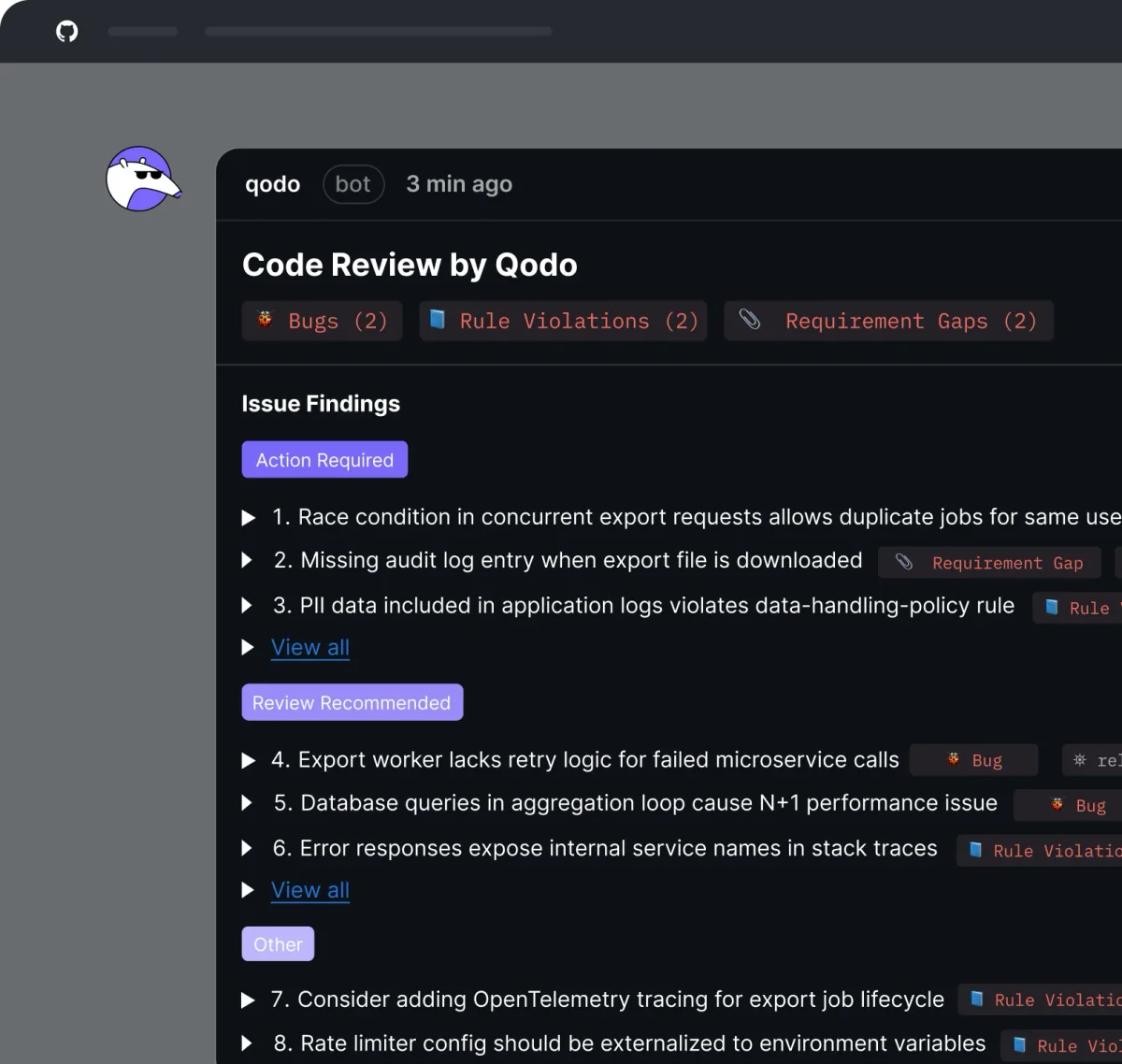
Automated code review findings with prioritized actions and recommendations.
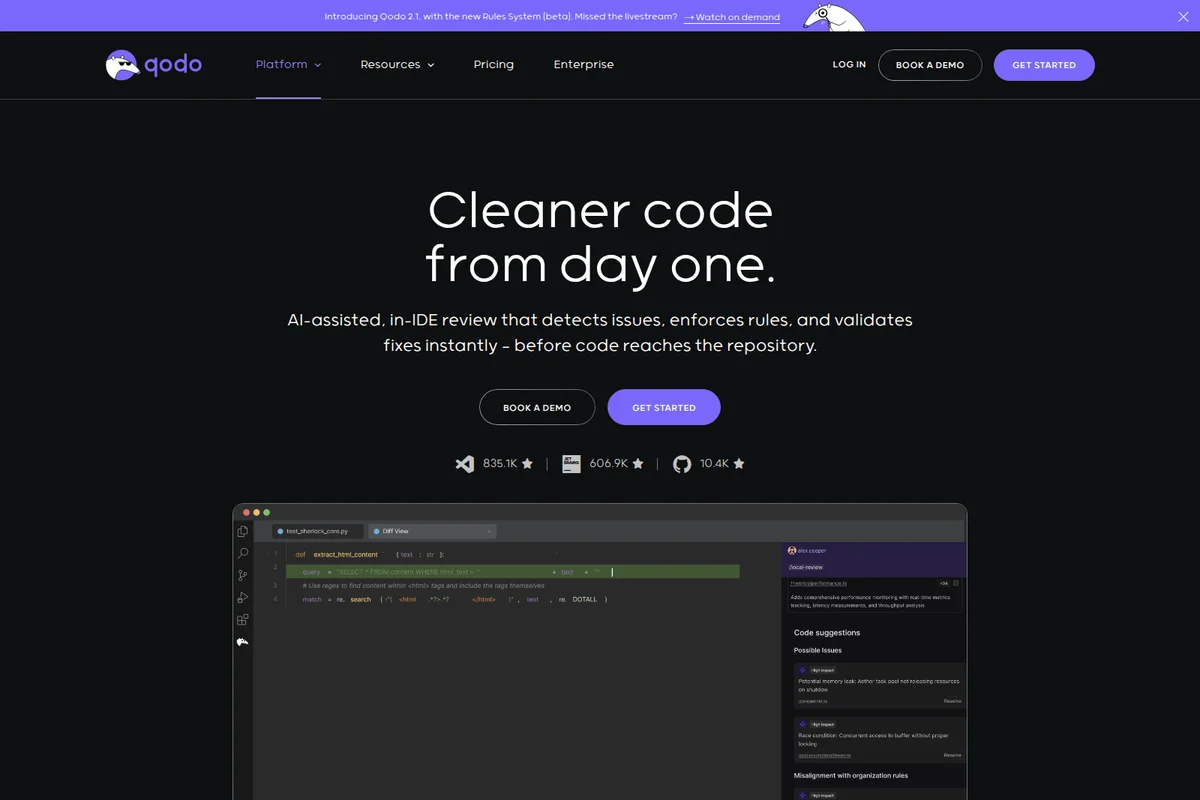
Catch critical code issues and enforce organizational rules instantly.
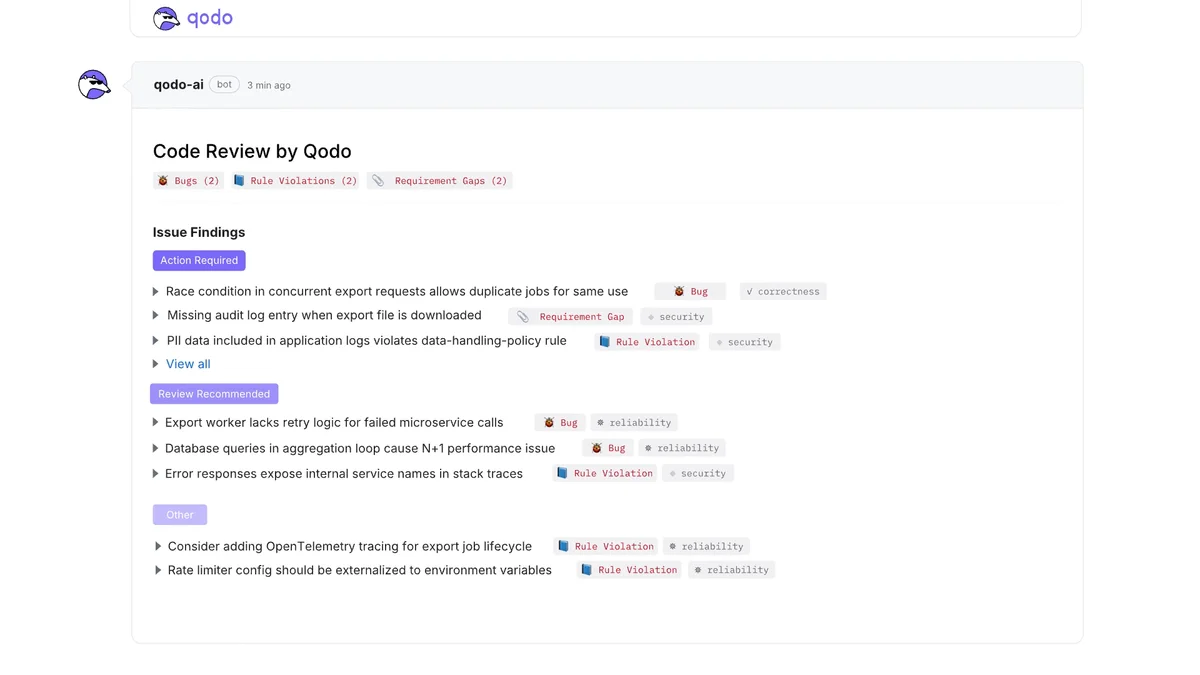
Understand code issues with AI-powered findings and clear recommendations.
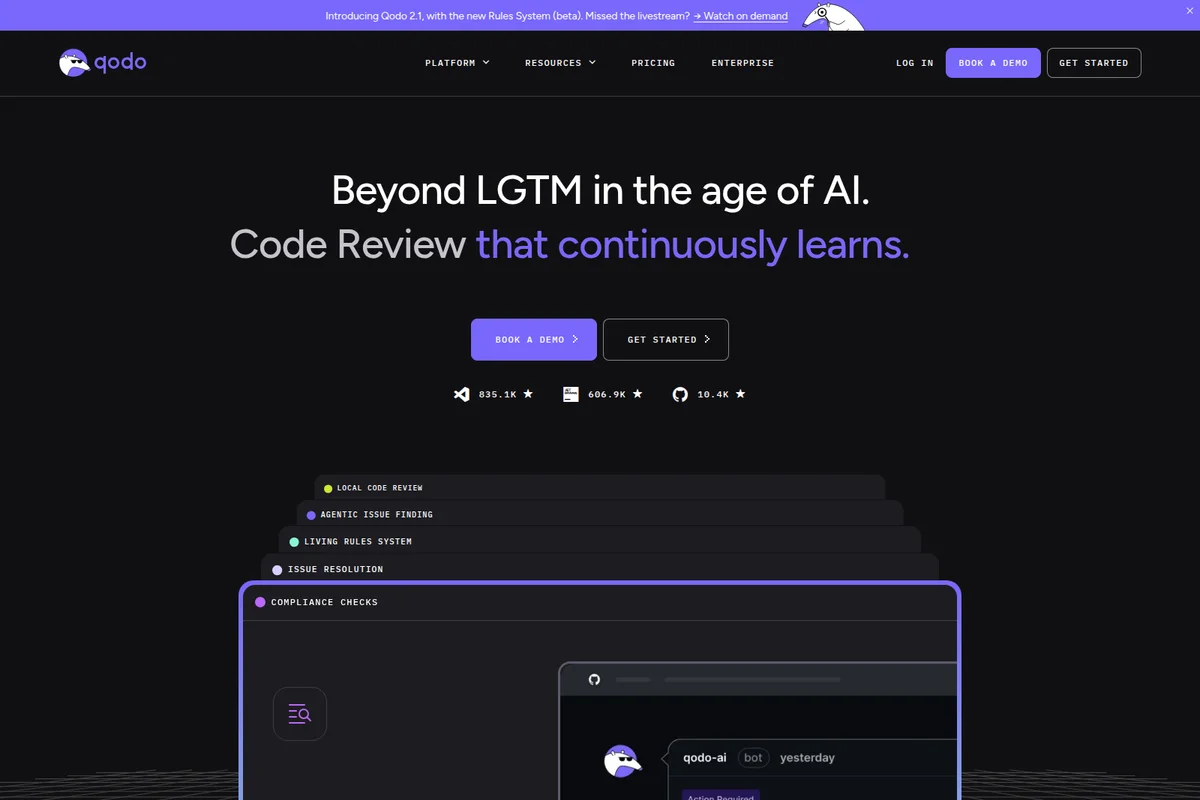
Elevate code review with AI that continuously learns and resolves issues.
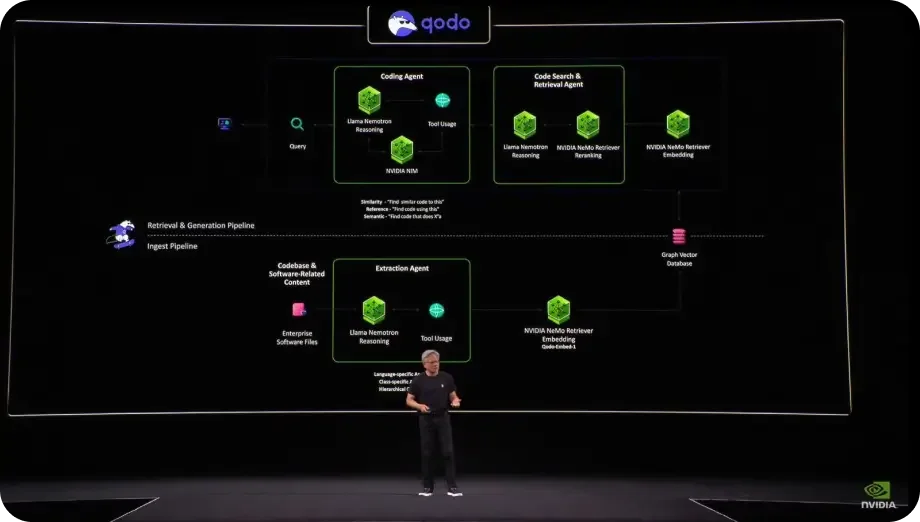
Explore Qodo's advanced AI architecture for code generation and intelligent retrieval.
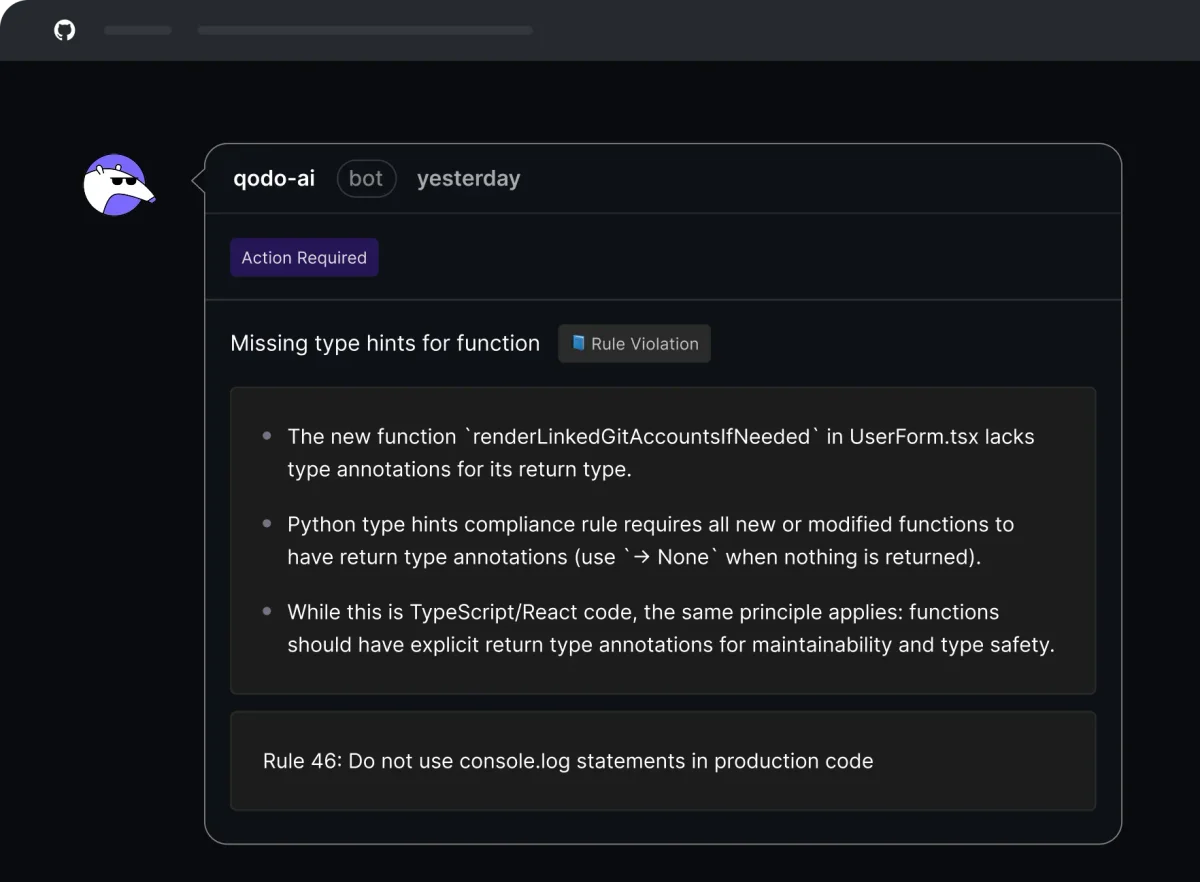
Automated code review identifies type hint and `console.log` violations.
Qodo Review: Tooliverse Consensus


Based on 2k+ verified reviews across 5 platforms,
combined with Tooliverse's expert analysis
Qodo pairs multi-agent pull request review with automated test generation, and reviewers credit that combination for catching edge cases and production-grade logic bugs that general-purpose assistants miss. Cross-repo awareness and model flexibility, including Claude and local Ollama, make it a category-defining option for quality-focused teams. The catches are real: credits drain fast under heavy use, cross-repo setup demands technical effort, very large codebases slow indexing, and there's no Copilot-style ghost-text autocomplete.
Bottom line: The category-defining choice for teams that treat AI code review as a quality gate, held back only by credits that drain fast under heavy use and a demanding cross-repo setup.
Qodo | Key Specs
- Platforms
- Web, IDE plugins (VS Code, JetBrains, Visual Studio), Git integrations, CLI
- Pricing Model
- Free 14-day trial + credit-based paid ($30+/mo), Enterprise custom See plans
- Privacy/Data Use
- Zero data retention, no training on customer code
- Security
- SOC 2 Type II, single-tenant/on-prem deployment, SSO/SAML (Enterprise) See details
Wins
- •Automates complex unit test generation with deep edge-case detectionmentioned in 342 reviews
- •Integrates multi-agent code reviews directly into pull request workflowsmentioned in 289 reviews
- •Provides high-precision logic verification that catches critical production bugsmentioned in 215 reviews
Watch-Outs
- •Free tier credit limits can be exhausted quickly by heavy workflowsmentioned in 84 reviews
- •Initial configuration for cross-repository context requires significant technical setupmentioned in 67 reviews
- •UI can experience noticeable latency when indexing very large enterprise codebasesmentioned in 52 reviews
Qodo Features 2026
Agentic Multi-Agent PR Review
Specialized agents run on every pull request with full codebase context, surfacing real bugs, rule violations and requirement gaps with less noise.
Wisdom Base / Context Engine
Pulls context from rules, codebase, PR history and business requirements to give a continuous, multi-dimensional understanding of complex codebases.
Rules & Skills Lifecycle
Self-learning rules mined from PR history and codebase conventions become machine-readable standards, with enforcement monitoring and rule health tracking.
Cross Repo Review
Catches breaking changes in shared SDKs, APIs or schemas that affect downstream repos, even across Git providers.
Qodo User Reviews
Selected Reviews
"Qodo stood out because it actually parsed the backend logic right, didn't choke on framework structure, and could tie in UI elements when asked. It's much deeper than Copilot for reviews."
"The multi-agent architecture in 2.0 is a game changer. It catches edge cases that standard LLMs miss because it looks at the code from multiple specialized perspectives simultaneously."
"Qodo's integrated review and test generation makes code quality actionable. It's the only platform that does both inside the same workflow, and that integration genuinely changes how you think about code quality as a solo developer."
More from the Community
"The test generation is top-tier, but the credit system is frustrating. I hit my limit halfway through a sprint and there's no easy way to top up without jumping to a much more expensive tier."
"Excellent for catching breaking changes in shared modules. The dependency graph awareness is something I haven't seen in other AI tools yet."
"Helpful but the UI gets laggy when I have more than 10 repos indexed. It's great for small projects, but enterprise scale needs more optimization."
"Finally an AI tool that understands that writing code is only 20% of the job. The other 80% is making sure it doesn't break everything else. Qodo gets this."
"The PR agent saves our team hours every week by summarizing changes and flagging logic errors before we even start the manual review."
"The test generation is top-tier, but the credit system is frustrating. I hit my limit halfway through a sprint and there's no easy way to top up without jumping to a much more expensive tier."
"Excellent for catching breaking changes in shared modules. The dependency graph awareness is something I haven't seen in other AI tools yet."
"Helpful but the UI gets laggy when I have more than 10 repos indexed. It's great for small projects, but enterprise scale needs more optimization."
"Finally an AI tool that understands that writing code is only 20% of the job. The other 80% is making sure it doesn't break everything else. Qodo gets this."
"The PR agent saves our team hours every week by summarizing changes and flagging logic errors before we even start the manual review."
"I use it alongside Copilot. Copilot writes the boilerplate, Qodo writes the tests and reviews the logic. It's the perfect stack for 2026."
"The local LLM support via Ollama is the main reason we chose Qodo. Privacy is non-negotiable for our firm, and this is the only tool that delivers high-quality reviews locally."
"Great tool, but the setup for cross-repo context was a bit of a headache. Once it's running it's amazing, but be prepared for some configuration work."
"It's a bit verbose sometimes. I don't need a 5-paragraph explanation for a simple syntax fix. Would love a 'concise mode' for the PR comments."
"I use it alongside Copilot. Copilot writes the boilerplate, Qodo writes the tests and reviews the logic. It's the perfect stack for 2026."
"The local LLM support via Ollama is the main reason we chose Qodo. Privacy is non-negotiable for our firm, and this is the only tool that delivers high-quality reviews locally."
"Great tool, but the setup for cross-repo context was a bit of a headache. Once it's running it's amazing, but be prepared for some configuration work."
"It's a bit verbose sometimes. I don't need a 5-paragraph explanation for a simple syntax fix. Would love a 'concise mode' for the PR comments."
Qodo Pricing 2026
View SourceStart with the 14-day trial, which gives unlimited reviews and credits with no card, then size Pro Team by review volume: the $30/month pack covers roughly 18 reviews, so busy teams will outgrow it quickly. Overage bills at the same per-credit rate under a cap you set, which beats being locked out mid-sprint. Credits expire monthly, so don't overbuy. Anything needing SSO, audit logs, or BYOK requires Enterprise.
Qodo In-Depth Review 2026

Qodo is an AI code review and governance platform that checks pull requests against more than the diff: it draws on team rules, the wider codebase, PR history, and business requirements from tickets and specs. It runs on GitHub, GitLab, Bitbucket, and Azure DevOps, with plugins for VS Code, JetBrains IDEs, and Visual Studio. Specialized agents flag bugs, duplicated logic, and rule violations with severity ratings and suggested fixes, and the same system generates unit tests. Qodo 3.0, launched on October 1, 2026, added a Software Map of how repos and services connect.
What It's Like Day-to-Day
On a typical pull request, the review agents run automatically and leave comments ranked by severity, each with a remediation suggestion. Team leads on G2 describe the PR agent as a time-saver that summarizes changes and flags logic errors before a human starts reading, which matters when the queue is long. Product Hunt reviewers credit the multi-agent design for catching edge cases that single-model tools miss, since each agent examines the code from a different angle.
Qodo Security & Compliance
Verified Compliance
- SOC 2 Type II
Security Features
- Single-tenant deployment
- On-premises / air-gapped deployment
- SSO / SAML (Enterprise)
- Audit logs (Enterprise)
- BYOK (bring your own LLM keys)
Privacy Commitments
- Zero data retention: code is analyzed and discarded, nothing stored, logged, or used to train models
- Does not train models on customer code
Qodo: Frequently Asked Questions (FAQs)
How much does Qodo cost?
Qodo's Pro Team plan is credit-based at $0.012 per credit, pooled across the team, with packs starting at $30/month for 2,500 credits (~18 reviews/month). Enterprise pricing is custom for 30+ users.
Does Qodo have a free trial?
Yes, Qodo offers a 14-day free trial with unlimited reviews and credits, and no credit card is required.
Is there a free plan?
No, Qodo does not offer a permanent free tier. After the trial you pick a paid plan, though qualified open source projects can apply for free access.
What is Qodo?
Qodo is an AI code review and governance platform for engineering teams. It reviews every pull request with cross-repo codebase context, enforces coding standards, and governs AI tools, across IDE and Git surfaces.
Qodo Integrations
| GitHub | GitLab | Bitbucket |
| Azure DevOps | Gerrit | VS Code |
| JetBrains | Visual Studio | Jira |
| PostgreSQL | Notion | Monday |
| Grafana | Linear | OpenAI |
| Anthropic | Azure OpenAI |
Qodo: Verified Data Sheet
| # | Label | Data Point |
|---|---|---|
| [1] | Qodo Consensus: 9.18/10 | Qodo is one of the highest-rated AI coding tools in the Tooliverse index, with a consensus score of 9.18/10 across 2,526 verified reviews. |
| [2] | What is Qodo | Qodo is a SOC 2 Type II certified AI code review and governance platform with multi-repo context and enforceable coding standards. It offers a 14-day free trial, with paid credit-based plans starting at $30/month. |
| [3] | Tooliverse Consensus on Qodo | Qodo pairs multi-agent pull request review with automated test generation, and reviewers credit that combination for catching edge cases and production-grade logic bugs that general-purpose assistants miss. Cross-repo awareness and model flexibility, including Claude and local Ollama, make it a category-defining option for quality-focused teams. The catches are real: credits drain fast under heavy use, cross-repo setup demands technical effort, very large codebases slow indexing, and there's no Copilot-style ghost-text autocomplete. |
| [4] | Qodo Verdict | Qodo bottom line: The category-defining choice for teams that treat AI code review as a quality gate, held back only by credits that drain fast under heavy use and a demanding cross-repo setup. |
| [5] | Free Trial: Free | Qodo offers a Free Trial tier that runs as a 14-day trial with no credit card required and Unlimited reviews, so teams can evaluate it at no cost. |
| [6] | Catches critical logic bugs pre-production | Qodo provides high-precision logic verification that catches critical production bugs, including breaking changes in shared modules across repositories, according to 215 user reviews. |
| [7] | Flexible models incl. Claude and Ollama | Qodo offers flexible model selection, including Claude 3.5 and local Ollama models, and 198 user reviews highlight this choice; bring-your-own-key (BYOK) works with OpenAI, Anthropic, Azure OpenAI or self-hosted models. |
| [8] | Open-source core for self-hosted reviews | Qodo maintains an open-source core that supports transparent, self-hosted code reviews, a strength noted in 156 user reviews. |
| [9] | Pro Team: $30/month | Qodo Pro Team costs $30 monthly and charges $0.012 per credit, pooled across the team, significantly expanding on the free tier's capabilities. |
| [10] | Deep edge-case unit test generation | Qodo automates complex unit test generation with deep edge-case detection, a strength cited in 342 user reviews, making it the capability reviewers mention most often. |
| [11] | Credits can run out quickly under heavy use | Qodo's credit-based plans can be exhausted quickly by heavy workflows, according to 84 user reports; the $30/month Pro Team pack includes 2,500 credits (about 18 reviews), and overage bills at the same per-credit rate up to a customer-set monthly cap. |
| [12] | Cross-repo context setup is technical | Qodo requires significant technical setup for initial cross-repository context configuration, according to 67 user reports. |
| [13] | Privacy: Zero data retention: code is analyzed and discarded, nothing stored, logged, or used to train models | Qodo protects privacy with Zero data retention: code is analyzed and discarded, nothing stored, logged, or used to train models and Does not train models on customer code. |
| [14] | Enterprise: Single-tenant deployment | Qodo delivers enterprise security through Single-tenant deployment, On-premises / air-gapped deployment, and SSO / SAML (Enterprise). |
| [15] | Review and testing in one workflow | Qodo's integrated review and test generation makes code quality actionable, and it is "the only platform that does both inside the same workflow," according to a verified G2 reviewer rating it 4/5. |
Best Qodo Alternatives
Greptile
AI code review that knows your whole codebase and catches the bugs humans miss.

Sourcery
Automated code reviews designed for security and speed in the AI era.
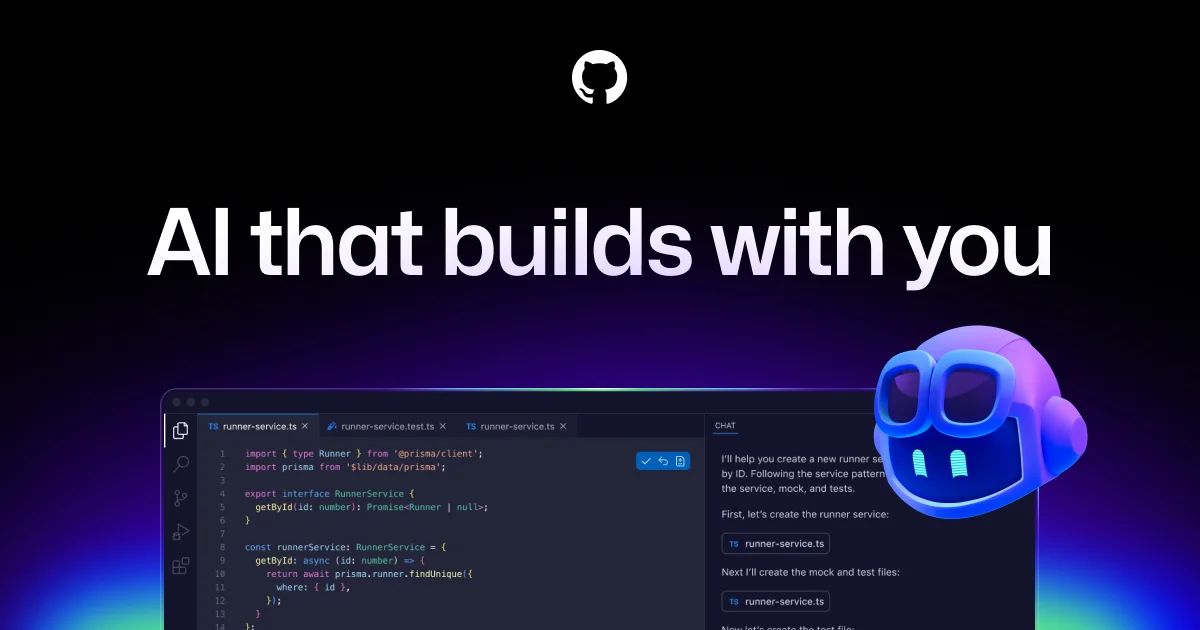
GitHub Copilot
Your AI accelerator for every workflow, from the editor to the enterprise.