
Semantic Scholar Review 2026 - Free AI Paper Search
Verified Oct 6, 2026 by Tooliverse Editorial
Semantic Scholar cuts through research overload with one-sentence TLDR summaries, influential citation flags, and personalized paper feeds. Search 238,594,066 papers across all fields of science, completely free, from the nonprofit Ai2.
Getting Started with Semantic Scholar Academic Graph API [Webinar]
Modern Literature Review AI Tools That Save Hours SEMANTIC SCHOLAR NOTEBOOKLM, CONSENSUS
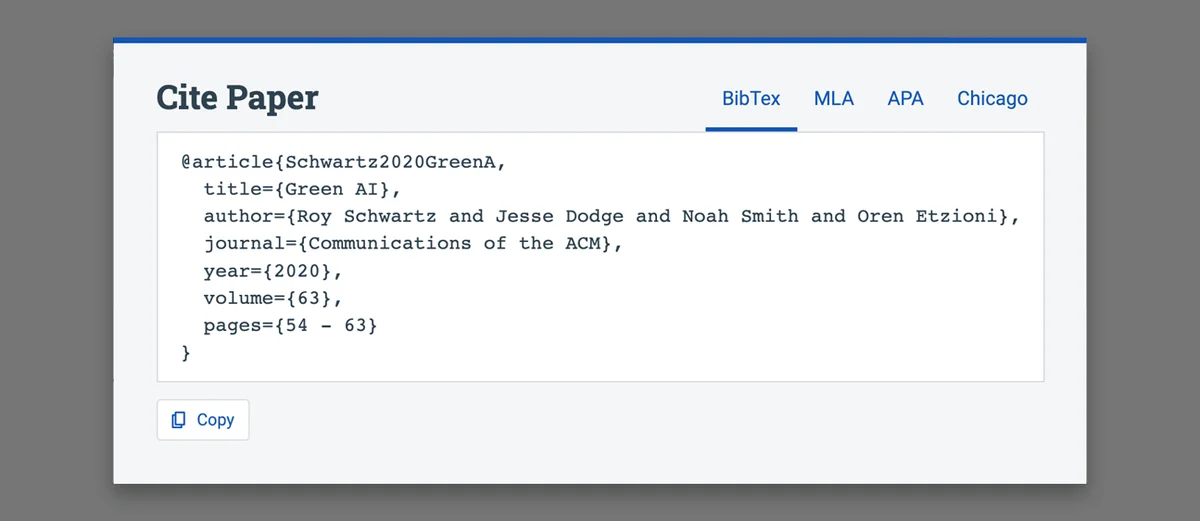
Generate and copy citations in multiple formats like BibTex, MLA, APA, and Chicago.
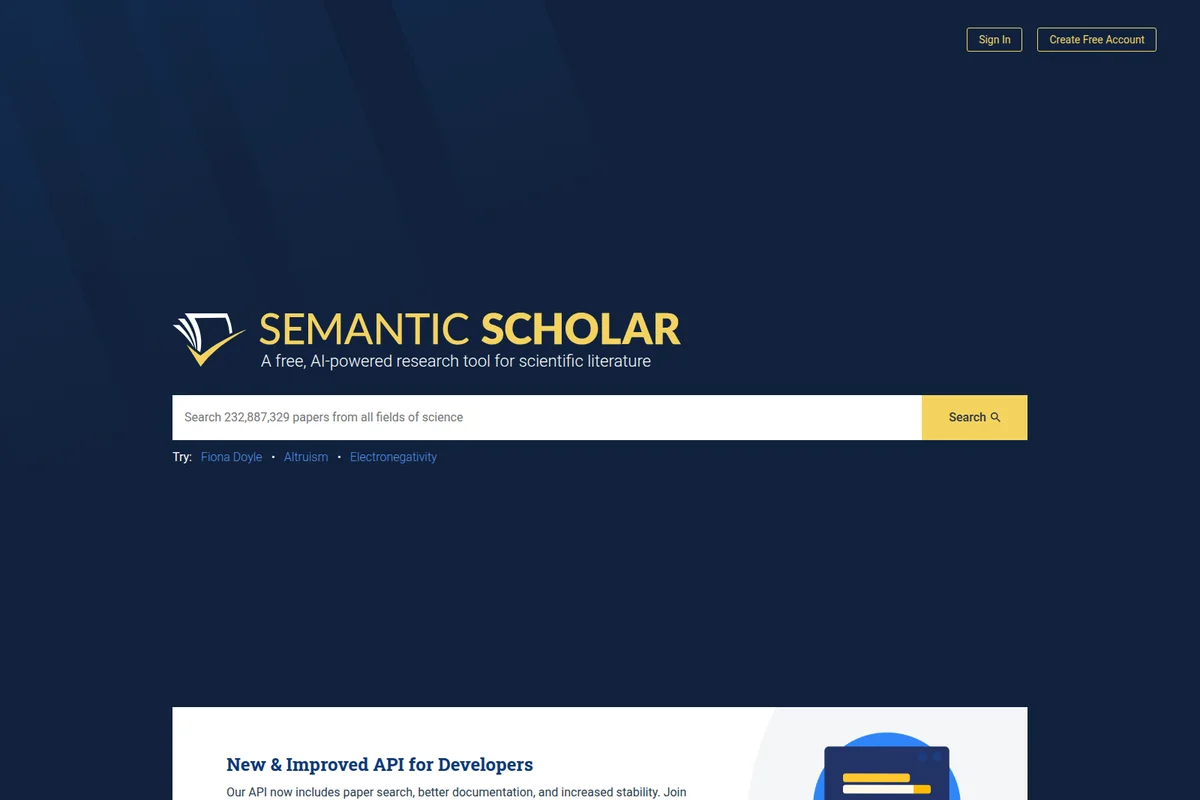
Discover over 230 million research papers with AI-powered search.
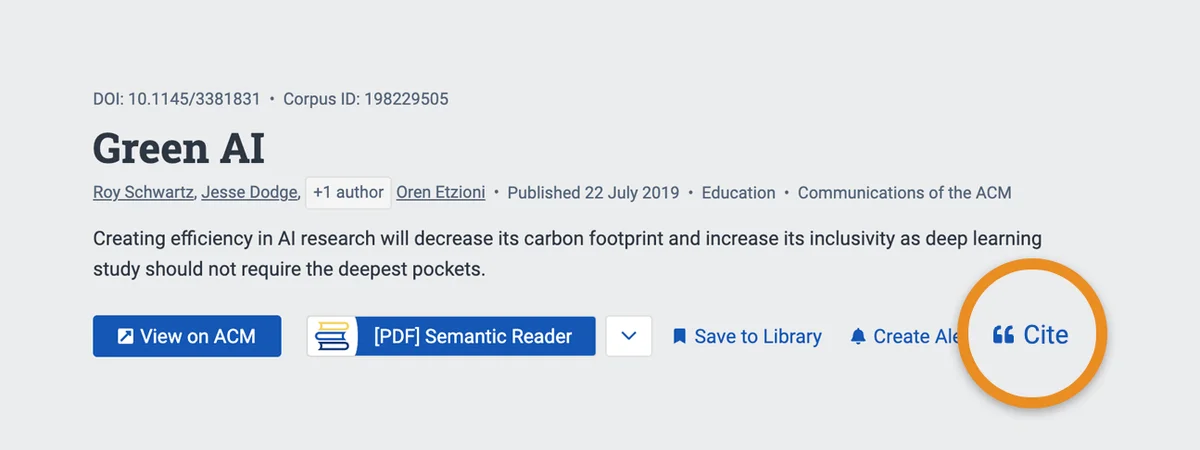
Generate citations in various formats directly from the article page.
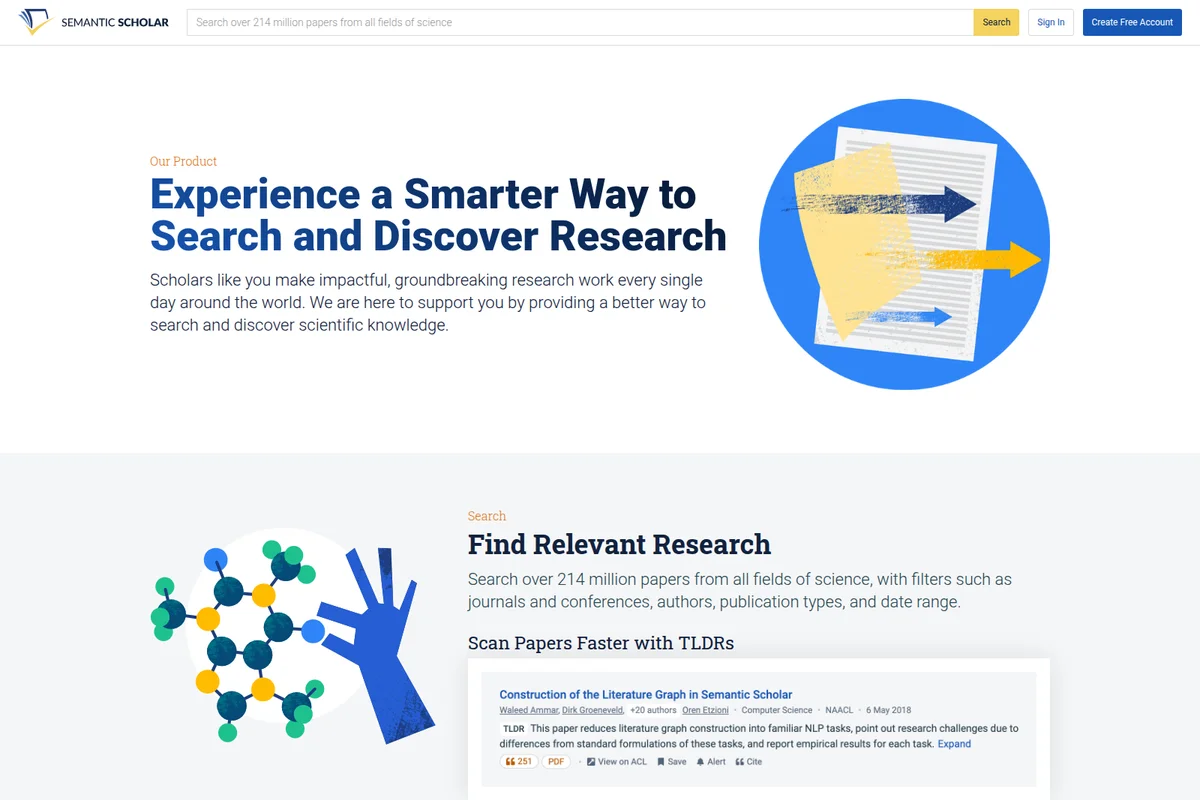
Experience intelligent research search and faster paper scanning with TLDRs.
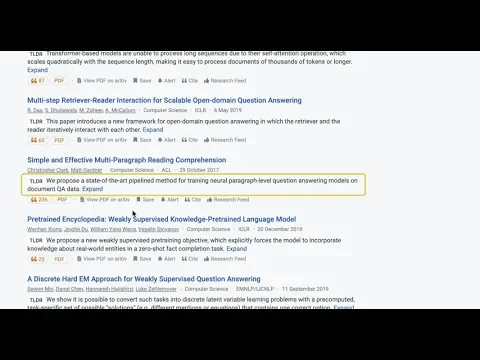
Quickly grasp paper content with AI-generated TLDR summaries.
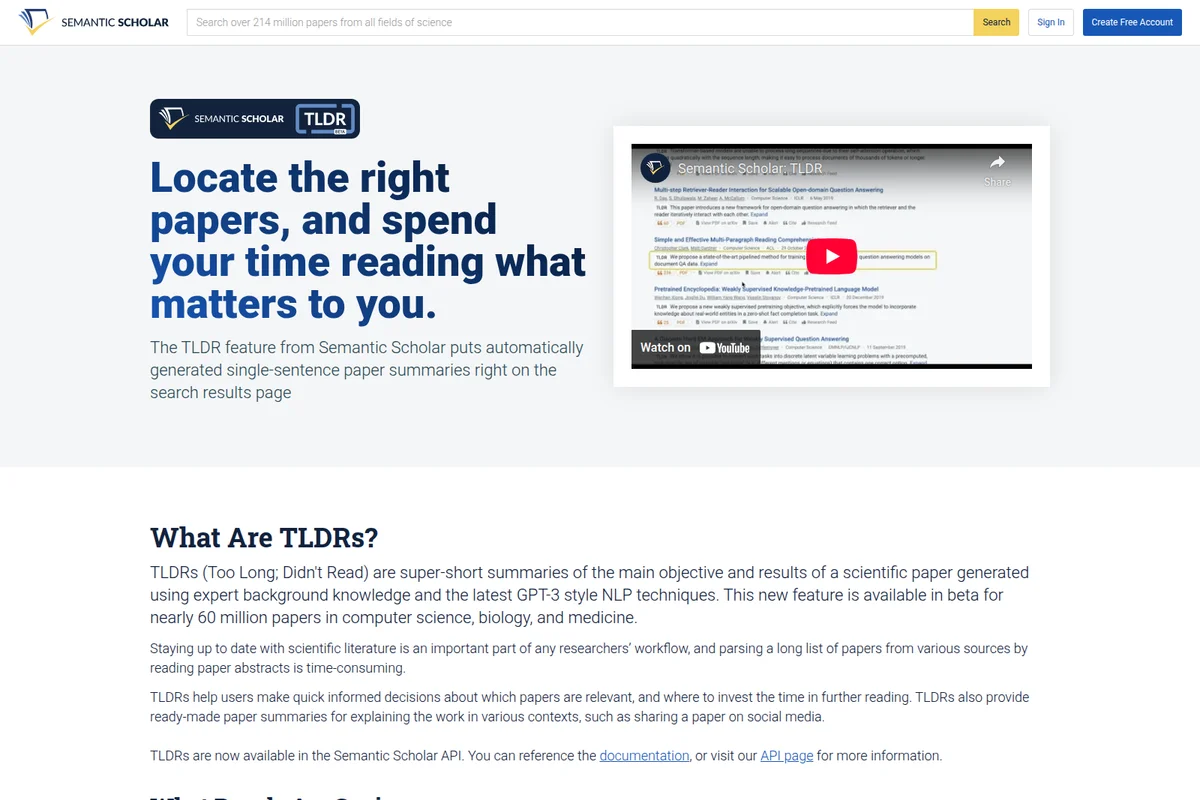
Locate relevant papers faster with AI-generated single-sentence summaries.
Visualize the intelligent extraction and flow of key information from research papers.
Semantic Scholar Review: Tooliverse Consensus



Based on 740 verified reviews across 4 platforms,
combined with Tooliverse's expert analysis
Semantic Scholar compresses the first pass of a literature search, pairing one-sentence TLDRs with influential-citation tags so researchers can judge a paper's contribution before reading it. Personalized feeds and the Semantic Reader overlay add depth, and the ad-free, nonprofit-run experience wins over people leaving Google Scholar. The tradeoffs are coverage and tooling: humanities and social sciences are thinner, TLDRs stay within computer science and biomedicine, and library management is basic enough that many users pair it with Zotero.
Bottom line: A top-tier, free research engine whose TLDRs and influential-citation tags make literature screening fast, though humanities coverage and basic library tools mean it works best alongside Zotero and other databases.
Semantic Scholar | Key Specs
- Platforms
- Web, API
- Pricing Model
- Free (no paid tiers) See plans
- Privacy/Data Use
- No sign-in credentials collected, account optional
- Security
- Privacy-focused institutional sign-in (Open Athens) See details
Wins
- •Provides AI-generated TLDR summaries that allow for rapid paper screeningmentioned in 156 reviews
- •Identifies highly influential citations to help researchers prioritize impactful literaturementioned in 134 reviews
- •Features an interactive Semantic Reader that overlays context directly onto PDFsmentioned in 112 reviews
Watch-Outs
- •Database coverage remains less comprehensive for humanities and social sciencesmentioned in 64 reviews
- •PDF extraction occasionally struggles with older or non-standard document formatsmentioned in 48 reviews
- •Search filters lack the granular depth found in specialized medical databasesmentioned in 39 reviews
Semantic Scholar Features 2026
AI-Powered Paper Search
Search 238,594,066 papers from all fields of science with filters for journals, conferences, authors, publication types, and date range.
TLDR Summaries
AI-generated single-sentence paper summaries on search results, available for nearly 60 million papers in computer science, biology, and medicine.
Highly Influential Citations
Machine-learning model identifies citations where the cited work significantly impacts the citing paper.
Citation Intent
Classifies citations as Background, Method, or Result Extension to ease navigation of the citation graph.
Semantic Scholar User Reviews
Selected Reviews
"Semantic Scholar's citation graph is much more intuitive than Google Scholar. Seeing the 'Highly Influential' tag helps prioritize reading when I'm starting a new topic."
"Semantic Reader's ability to show figures and tables in a side pane while reading is a game changer for data-heavy papers. No more scrolling back and forth!"
"Semantic Reader's inline definitions for technical terms are fantastic for students. It makes dense papers much more accessible without constant googling."
More from the Community
"The TLDR feature is a lifesaver for literature reviews. It helps me filter out irrelevant papers in seconds without having to read every abstract."
"The library function is a bit primitive, so you may want to use Zotero or Mendeley to store and organise the papers as they extract metadata better."
"The Chrome extension is helpful but it often fails to detect PDFs on certain university library proxy sites which is frustrating during deep research sessions."
"Best academic search engine out there. The clean UI and lack of ads make it a much better experience than ResearchGate or even Google Scholar for daily use."
"The 'Research Feeds' feature is like a personalized newspaper for my specific sub-field. I haven't missed an important paper in months since setting it up."
"The TLDR feature is a lifesaver for literature reviews. It helps me filter out irrelevant papers in seconds without having to read every abstract."
"The library function is a bit primitive, so you may want to use Zotero or Mendeley to store and organise the papers as they extract metadata better."
"The Chrome extension is helpful but it often fails to detect PDFs on certain university library proxy sites which is frustrating during deep research sessions."
"Best academic search engine out there. The clean UI and lack of ads make it a much better experience than ResearchGate or even Google Scholar for daily use."
"The 'Research Feeds' feature is like a personalized newspaper for my specific sub-field. I haven't missed an important paper in months since setting it up."
"Really impressive how it identifies the specific contribution of a paper. Saves me from reading the whole intro just to find the research gap."
"The most useful tool in my PhD toolkit. The way it links related work through semantic analysis rather than just keywords is brilliant and saves hours."
"I've completely switched from Google Scholar. The AI summaries are just too good to ignore when you have 50+ papers to skim every week."
"Helpful but the search filters could be more robust for medical journals. Sometimes it's hard to narrow down by specific clinical trial phases."
"Really impressive how it identifies the specific contribution of a paper. Saves me from reading the whole intro just to find the research gap."
"The most useful tool in my PhD toolkit. The way it links related work through semantic analysis rather than just keywords is brilliant and saves hours."
"I've completely switched from Google Scholar. The AI summaries are just too good to ignore when you have 50+ papers to skim every week."
"Helpful but the search filters could be more robust for medical journals. Sometimes it's hard to narrow down by specific clinical trial phases."
Semantic Scholar Pricing 2026
Everything here costs nothing, so the real decision is whether to make an account. Do it: the free account adds the library, Research Feeds, and email alerts that turn one-off searches into a standing reading list, and setup takes a minute. Developers get the API at no charge too, but the introductory limit of 1 request per second per key is tight, so plan prototypes around that ceiling.
Semantic Scholar In-Depth Review 2026

Semantic Scholar is a free academic search engine from the nonprofit Ai2, indexing roughly 238 million papers across all fields of science. It uses machine learning to extract meaning from papers, then surfaces one-sentence TLDR summaries, highly influential citations, and citation intents labeled Background, Method, or Result Extension. It runs in the browser on desktop and mobile, needs no account to read papers, and also offers a free API and downloadable datasets for developers building scholarly tools.
What It's Like Day-to-Day
The daily rhythm centers on scanning. Search results carry TLDRs, single sentences of about 20 words in place of 200-word abstracts, and reviewers describe clearing a results page in minutes. One Reddit user calls the feature "a lifesaver for literature reviews" because it filters out irrelevant papers without a close read of every abstract. TLDRs cover nearly 60 million papers in computer science, biology, and medicine, so researchers in other fields will see fewer of them.
Once a paper looks promising, the citation graph takes over.
Semantic Scholar Security & Compliance
Security Features
- Privacy-focused institutional sign-in via Open Athens
Privacy Commitments
- Semantic Scholar does not collect sign-in information such as username or password
- Account creation not required to access papers
Semantic Scholar: Frequently Asked Questions (FAQs)
Is Semantic Scholar free?
Yes, Semantic Scholar is a free, AI-powered research tool for scientific literature. Creating an account is also free, and you do not need an account to access papers.
What is the advantage of using Semantic Scholar instead of other academic search engines?
Semantic Scholar uses machine learning to extract meaning and identify connections within papers, then surfaces these insights to help scholars understand literature quickly. Its mission is to accelerate scientific breakthroughs by helping scholars locate and understand the right research.
Does Semantic Scholar offer an API or downloadable datasets?
Yes, it offers the Academic Graph RESTful API, monthly-updated downloadable datasets, a peer review service, and the S2ORC corpus. Published research using this data should cite it properly.
Do I need an API key for the Semantic Scholar API?
Most endpoints are available without authentication but are rate-limited to 1000 requests per second shared among all unauthenticated users. Some endpoints require an API key, which has an introductory limit of 1 RPS on all endpoints.
Semantic Scholar Integrations
| Zotero | Mendeley | Hypothesis |
| GetFTR | LibKey | Open Athens |
| EndNote | PubMed | |
| arXiv |
Semantic Scholar: Verified Data Sheet
| # | Label | Data Point |
|---|---|---|
| [1] | Semantic Scholar Consensus: 9.08/10 | Semantic Scholar is one of the highest-rated AI research tools in the Tooliverse index, with a consensus score of 9.08/10 across 740 verified reviews. |
| [2] | What is Semantic Scholar | Semantic Scholar, built by nonprofit Ai2, is a free AI-powered research tool for scientific literature. It searches 238 million papers with TLDR summaries, influential citations, and a free API. |
| [3] | Tooliverse Consensus on Semantic Scholar | Semantic Scholar compresses the first pass of a literature search, pairing one-sentence TLDRs with influential-citation tags so researchers can judge a paper's contribution before reading it. Personalized feeds and the Semantic Reader overlay add depth, and the ad-free, nonprofit-run experience wins over people leaving Google Scholar. The tradeoffs are coverage and tooling: humanities and social sciences are thinner, TLDRs stay within computer science and biomedicine, and library management is basic enough that many users pair it with Zotero. |
| [4] | Semantic Scholar Verdict | Semantic Scholar bottom line: A top-tier, free research engine whose TLDRs and influential-citation tags make literature screening fast, though humanities coverage and basic library tools mean it works best alongside Zotero and other databases. |
| [5] | Free: Free | Semantic Scholar offers a Free tier that covers search across all fields of science and TLDR paper summaries, putting AI research tools within reach at no cost. |
| [6] | Adaptive personalized Research Feeds | Semantic Scholar builds personalized Research Feeds that adapt to a user's reading behavior and saved library folders over time, and sends email alerts for new papers. 98 user reviews highlight the feature. |
| [7] | Free, ad-free public research good | Semantic Scholar is completely free and ad-free, and an account is not required to access papers. 76 user reviews mention this, and the nonprofit Ai2 builds it as a public research good. |
| [8] | TLDRs speed up paper screening | Semantic Scholar generates AI-written single-sentence TLDR summaries of about 20 words, compared with about 200 for an abstract, for nearly 60 million papers in computer science, biology, and medicine. 156 user reviews cite them as the fastest way to screen papers. |
| [9] | Influential citations and citation intent | Semantic Scholar uses a machine-learning model to flag Highly Influential Citations and labels citation intent as Background, Method, or Result Extension. 134 user reviews credit this with helping researchers prioritize impactful literature. |
| [10] | Thinner humanities and social science coverage | Semantic Scholar offers less comprehensive database coverage for humanities and social sciences, according to 64 user reports. It also focuses primarily on English-language papers, with very limited book coverage and no patents. |
| [11] | PDF extraction struggles with older formats | Semantic Scholar's PDF extraction occasionally struggles with older or non-standard document formats, according to 48 user reports. |
| [12] | Privacy: Semantic Scholar does not collect sign-in information such as username or password | Semantic Scholar protects user privacy: Semantic Scholar does not collect sign-in information such as username or password, and Account creation not required to access papers. |
| [13] | Enterprise: Privacy-focused institutional sign-in via Open Athens | Semantic Scholar secures institutional access through Privacy-focused institutional sign-in via Open Athens. |
| [14] | TLDRs filter irrelevant papers in seconds | Semantic Scholar's TLDR feature is "a lifesaver for literature reviews" that filters out irrelevant papers in seconds, according to a Reddit reviewer who rated it 5/5. |
Best Semantic Scholar Alternatives
Elicit
Understand what science already knows, so you can discover the unknown, with evidence you can trace.
Consensus
Get evidence-backed answers from 220M+ peer-reviewed papers instead of drowning in search results.
Undermind
Find the papers others miss and build real command of your research field with AI that reads the literature for you.