
AssemblyAI vs Deepgram: Insight Extraction or Real-Time Conversation Speed (2026)
Verified Sep 22, 2026 by Tooliverse Editorial
AssemblyAI and Deepgram are both speech-to-text and voice AI APIs aimed at developers building transcription, captioning, and voice agent products, with pricing tiers spanning free prototyping to enterprise deployments.
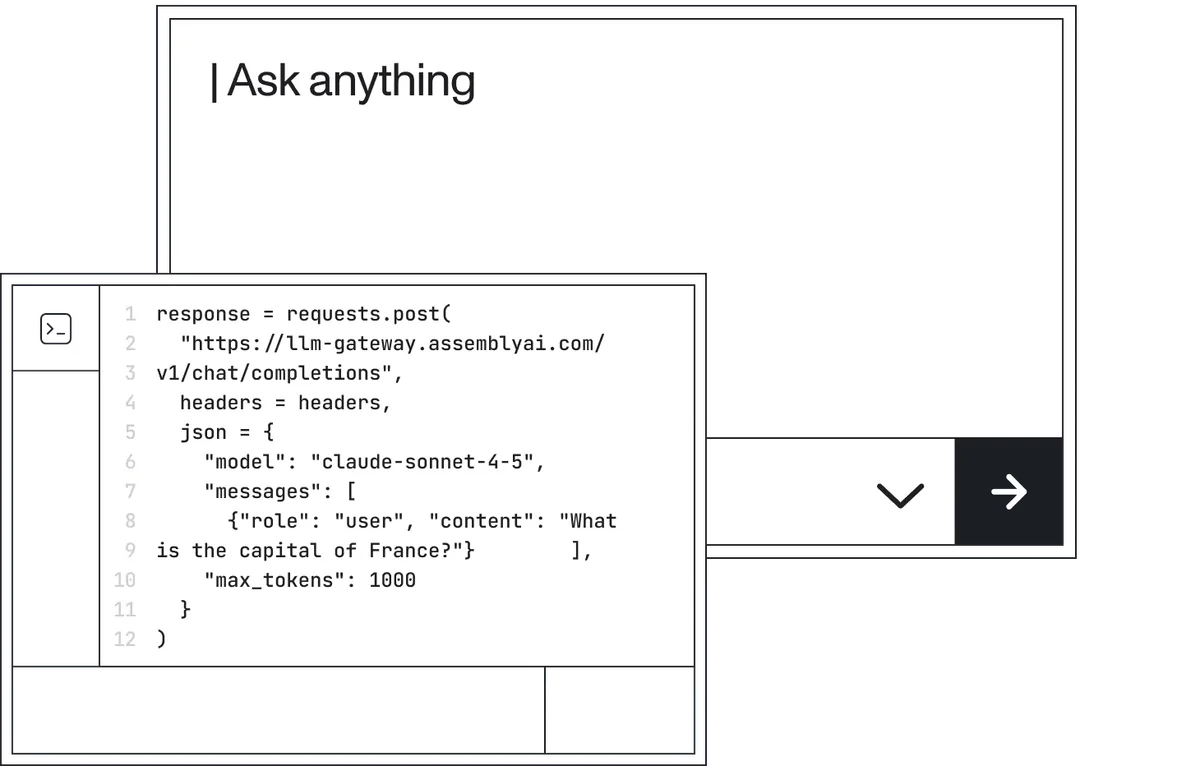
 AssemblyAI
AssemblyAI feature deep dive showing an LLM API call in a code editor and a chat input field with a dark theme.
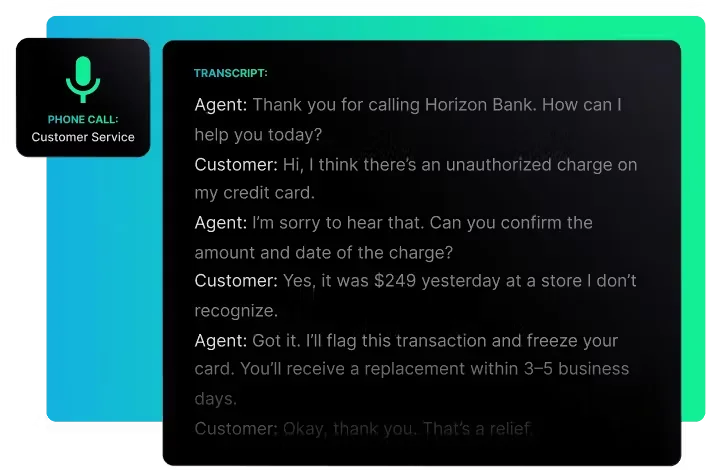
Deepgram workspace UI showing a real-time customer service phone call transcript with a dark-mode interface
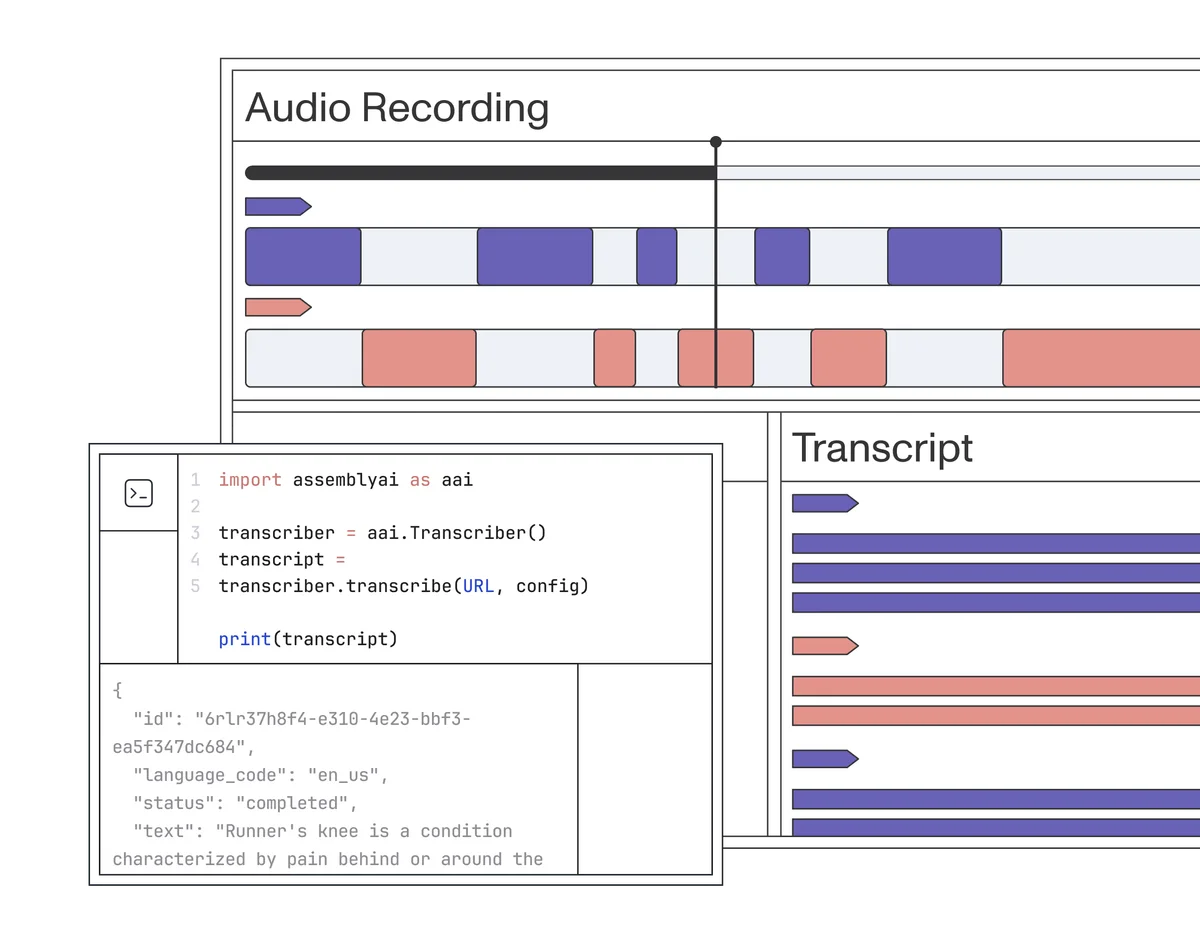 AssemblyAI
AssemblyAI transcription workflow showing an audio recording timeline, Python code, and a color-coded text transcript output.
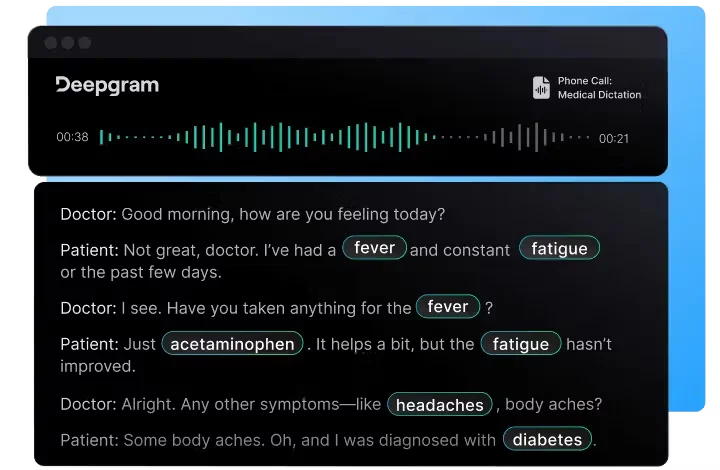
Deepgram workspace showing AI-powered medical dictation transcription with highlighted symptoms and medications in a dark-mode interface.
AssemblyAI vs Deepgram Review: Tooliverse Consensus



Based on 727 verified reviews across 6 platforms,
combined with Tooliverse's expert analysis
Both tools earn strong reviewer scores — AssemblyAI 8.06/10 from 450 reviews, Deepgram 9.33/10 from 277 reviews — but for different reasons. AssemblyAI reviewers highlight accuracy on complex audio, heavy accents, and technical terminology (184 mentions), plus the LeMUR framework for pulling structured insight from recordings. Deepgram reviewers emphasize near-instantaneous transcription speed (156 mentions) and pricing that undercuts legacy providers (114 mentions), suiting latency-sensitive voice agents. AssemblyAI's watch-out is cost at scale for high-volume production; Deepgram's is a learning curve around advanced features like diarization.
Bottom line: Pick AssemblyAI for accuracy-critical transcription and audio-to-insight workflows via LeMUR; pick Deepgram for latency-sensitive voice agents and live captioning where real-time speed and per-second billing matter most.
Where Each Tool Wins
Strengths unique to each tool (what both do well is covered further down)
AssemblyAI- •Delivers unmatched accuracy for complex audio including heavy accents and technical terminologymentioned in 184 reviews
- •Utilizes the powerful LeMUR framework to extract high-level insights from audio filesmentioned in 98 reviews
- •Maintains highly competitive pricing that significantly undercuts legacy cloud providersmentioned in 114 reviews
- •Excels at real-time streaming for voice agents and live captioning productsmentioned in 98 reviews
Each Tool’s Watch-Outs
Drawbacks unique to each tool
AssemblyAI- •Supports fewer niche languages compared to some larger legacy cloud competitorsmentioned in 38 reviews
- •API error messages are sometimes too generic for troubleshooting complex integration issuesmentioned in 31 reviews
- •Lacks an on-premise or offline SDK for clients with strict data privacy requirementsmentioned in 27 reviews
- •Pricing structure for high-volume enterprise tiers can be complex to navigatementioned in 37 reviews
- •Support response times vary significantly depending on the user's subscription levelmentioned in 29 reviews
- •Occasional hallucinations occur when processing extremely low-quality or distorted audio filesmentioned in 22 reviews
Which Tool Is Best for Your Use Case?
| Use case | AssemblyAI | |
|---|---|---|
Real-time voice agents Deepgram reviewers cite industry-leading transcription speed and near-instantaneous real-time processing (156 mentions), while AssemblyAI offers sub-300ms latency and 142 mentions of low latency for live streaming. | Strong | Excellent |
Complex or accented audio transcription AssemblyAI reviewers specifically praise accuracy on heavy accents and technical terminology (184 mentions), while Deepgram's Nova-2 model draws 142 mentions for accuracy in noisy environments. | Excellent | Strong |
Audio-to-insight (summaries, sentiment, chapters) AssemblyAI's LeMUR framework for extracting high-level insights draws 98 dedicated mentions, while Deepgram covers similar ground with its Audio Intelligence feature for summarization, sentiment, intent, and topics. | Excellent | Strong |
Budget-conscious prototyping AssemblyAI's free tier offers 185 hours of pre-recorded and 333 hours of streaming transcription with no credit card, while Deepgram's Pay As You Go includes $200 in free credit and reviewers note pricing that significantly undercuts legacy providers (114 mentions). | Strong | Excellent |
Regulated or privacy-strict deployment AssemblyAI lacks an on-premise or offline SDK per its own watch-outs (27 mentions), whereas Deepgram offers self-hosted/VPC deployment plus HIPAA and SOC 2 Type II compliance with signed BAAs. | Fair | Excellent |

Speed and accuracy don't always want the same tool, and this matchup proves it. Reviewers who praised Deepgram's near-instantaneous transcription were rarely the same voices citing AssemblyAI's handling of heavy accents and technical jargon — two different production problems, each rated on its own terms. Both scores reflect real strengths, not one tool falling short. If the workflow lives or dies on accuracy for messy, jargon-heavy audio, AssemblyAI's Universal-2 tier at $0.15/hour is the practical default; if latency and telephony-grade noise are the bottleneck, Deepgram's $200 free credit is enough to prove it before Growth's annual commitment makes sense.
AssemblyAI vs Deepgram Pricing 2026
AssemblyAIFree Tier
- Up to 185 hours of pre-recorded transcription
- Up to 333 hours of streaming transcription
- No credit card required
- Up to 5 new streaming connections per minute
- Access to Playground
Growth
- Save up to 20% with pre-paid annual credits
- Higher concurrency limits (up to 225 WSS for STT, 60 for TTS/Voice Agent)
- Priority support beyond community/Discord
- Credits redeemed against actual usage
- Starting commitment $4K+/year
The Costs the Pricing Pages Don't Mention
- Add-on fees stack up
- AssemblyAI's per-hour pricing excludes extras like Keyterms Prompting ($0.05/hr), Speaker Diarization ($0.02/hr), and Medical Mode ($0.15/hr), which can raise the effective rate above the headline price.
- Production tier requires annual commitment
- Deepgram's Growth tier starts at a $4,000+/year commitment billed annually to unlock higher concurrency and priority support beyond community/Discord.
- Enterprise pricing is fully custom
- Both AssemblyAI and Deepgram list Enterprise tiers with no published price, requiring direct sales contact for custom concurrency, deployment, and volume discounts.
- Usage-based costs scale with volume
- AssemblyAI's own watch-outs note costs can escalate significantly for high-volume enterprise production workloads (64 mentions), a risk shared by any usage-based pricing model as traffic grows.
AssemblyAI vs Deepgram: Feature Comparison
As advertised on each tool's own site — "not advertised" doesn't necessarily mean missing.
| Feature | AssemblyAI | |
|---|---|---|
| Both tools | ||
| Pre-recorded speech-to-text | ✓ | ✓ |
| Real-time streaming transcription | ✓ | ✓ |
| Voice agent orchestration | ✓ | ✓ |
| Speaker diarization | ✓ | ✓ |
| Summarization and content analysis | ✓ | ✓ |
| Sentiment analysis | ✓ | ✓ |
| PII redaction | ✓ | ✓ |
| Domain-specific term boosting | ✓ | ✓ |
| Self-hosted / on-premise deployment | ✓ | ✓ |
| HIPAA / regulated healthcare compliance | ✓ | ✓ |
| LLM routing / orchestration | ✓ | ✓ |
| Text-to-speech | ✓ | ✓ |
| Automatic language detection | ✓ | ✓ |
| Highlighted by AssemblyAI | ||
| Dictation-specific transcription | ✓ | not advertised |
| Highlighted by Deepgram | ||
| Telephony audio support | not advertised | ✓ |
AssemblyAI vs Deepgram: User Reviews
Selected to show the range — the strongest praise and the most useful criticism for each.
AssemblyAIAssemblyAI"LeMUR is a game changer for our podcast summaries. It doesn't just transcribe; it actually understands the context of the conversation."
"Deepgram is the specialist choice for low-latency speech infrastructure. It's not the simplest for batch files, but for live voice, it's #1."
AssemblyAI"The PII redaction feature is a lifesaver for our compliance team. It automatically scrubs sensitive data before we store transcripts."
"Deepgram's API is the most stable we've used. Integration took less than an hour and it handles high concurrency without breaking a sweat."
AssemblyAI"Great API, but the dashboard analytics could be more detailed. I want to see usage broken down by API key more easily."
"Proactive in addressing real-time detection issues. The new Flux model solved our end-of-utterance detection problems which were critical for our bot."
AssemblyAI vs Deepgram: Frequently Asked Questions (FAQs)
Which is more accurate, AssemblyAI or Deepgram?
AssemblyAI reviewers most frequently praise accuracy on complex audio, heavy accents, and technical terminology (184 mentions), while Deepgram reviewers praise Nova-2's accuracy in noisy, telephony-grade environments (142 mentions). Both scored well overall, with Deepgram at 9.33/10 and AssemblyAI at 8.06/10 from their respective review pools.
Which tool is cheaper for prototyping?
AssemblyAI's free tier includes 185 hours of pre-recorded transcription and 333 hours of streaming with no credit card required. Deepgram's Pay As You Go tier offers $200 in free credit with no credit card, which its pricing summary estimates covers around 700 hours of transcription before charges begin.
Does either tool support on-premise or self-hosted deployment?
Deepgram explicitly offers Flexible Deployment across cloud, dedicated VPC, or fully self-hosted on-premise with NVIDIA GPUs, plus HIPAA and SOC 2 Type II compliance. AssemblyAI does offer Self-Hosted Voice AI for running models in your own environment, though its own watch-outs note it lacks an offline SDK for strict privacy requirements (27 mentions).
Which tool is better for building voice agents?
Both offer dedicated Voice Agent APIs: AssemblyAI's is priced at $4.50/hr all-inclusive covering STT, LLM, and TTS with no add-on fees, while Deepgram's Standard tier starts at $0.075/min Pay As You Go with BYO LLM/TTS options and an equivalent flat-rate $4.50/hr full-stack option. Deepgram reviewers give real-time voice agent performance 98 mentions for excelling at streaming, while AssemblyAI's Voice Agent API bundles turn detection and interruption handling natively.
How many languages does each tool support?
AssemblyAI's Universal-2 pre-recorded model supports 99 languages, while its Universal-3.5 Pro and Realtime models support 18 languages. Deepgram's Nova-3 model supports 45+ languages with automatic language detection.
How this comparison works
Consensus Scores aggregate verified reviews from 8 platforms — Reddit, Product Hunt, G2, Capterra, app stores and more — weighted by source reliability.
Features and pricing come from each tool's official site, last verified Sep 22, 2026. Verdicts are computed from this data.
The Editor's Note is our experts' read of what the data means for your decision — and comparison placement is never for sale. Editorial Policy
Best AssemblyAI & Deepgram Alternatives
Sonix
Turn audio and video into searchable, structured intelligence with 99% accurate AI transcription.

Cartesia
Speech generation, transcription, and voice agents fast enough for real conversation, powered by frontier AI research.
Vapi
Build voice agents that sound human, respond in under 500ms, and scale to millions of calls.

HappyScribe
Turn every meeting, interview and video into accurate notes and subtitles in 150+ languages.

Retell AI
Build, deploy, and manage AI voice agents that sound human, execute tasks, and scale effortlessly.