
BaseRock AI Review 2026 - Autonomous Testing
Verified Mar 15, 2026 by Tooliverse Editorial
BaseRock AI automates unit, integration, and functional testing using AI agents trained like expert QA engineers. Achieve 80%+ code coverage with one click—no manual test writing, no maintenance overhead. Trusted by developers at Apple, Samsung, and Nike.
AI Functional Testing Tutorial | BaseRock.ai Demo with GitHub
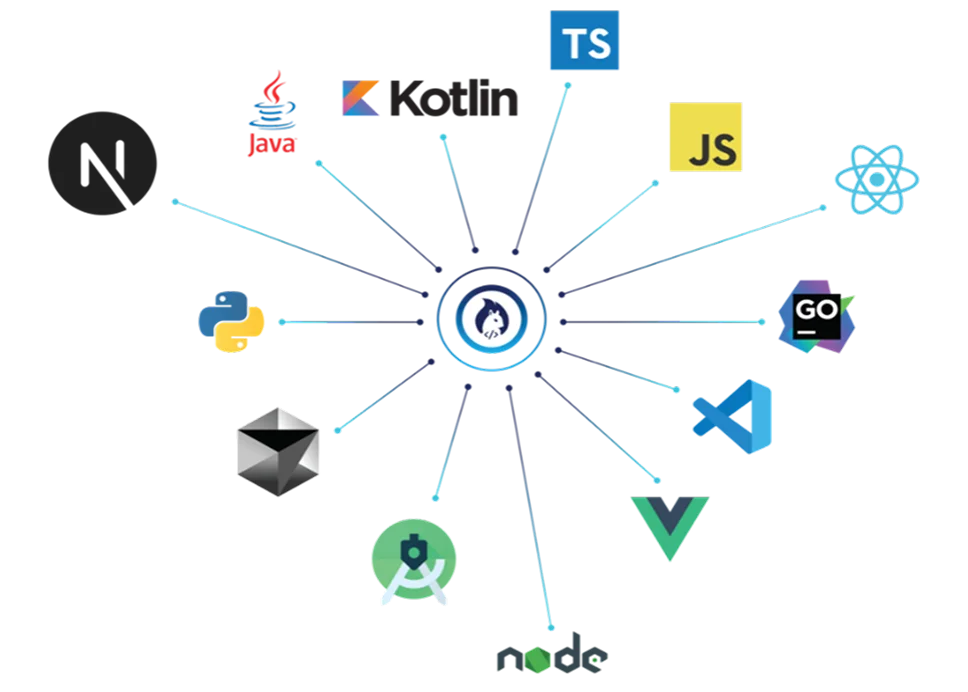
Leverage Baserock-AI across all major programming languages and frameworks.
Understand and mitigate the business risks of AI-powered development.

Learn about ensuring your web applications work across all browsers.
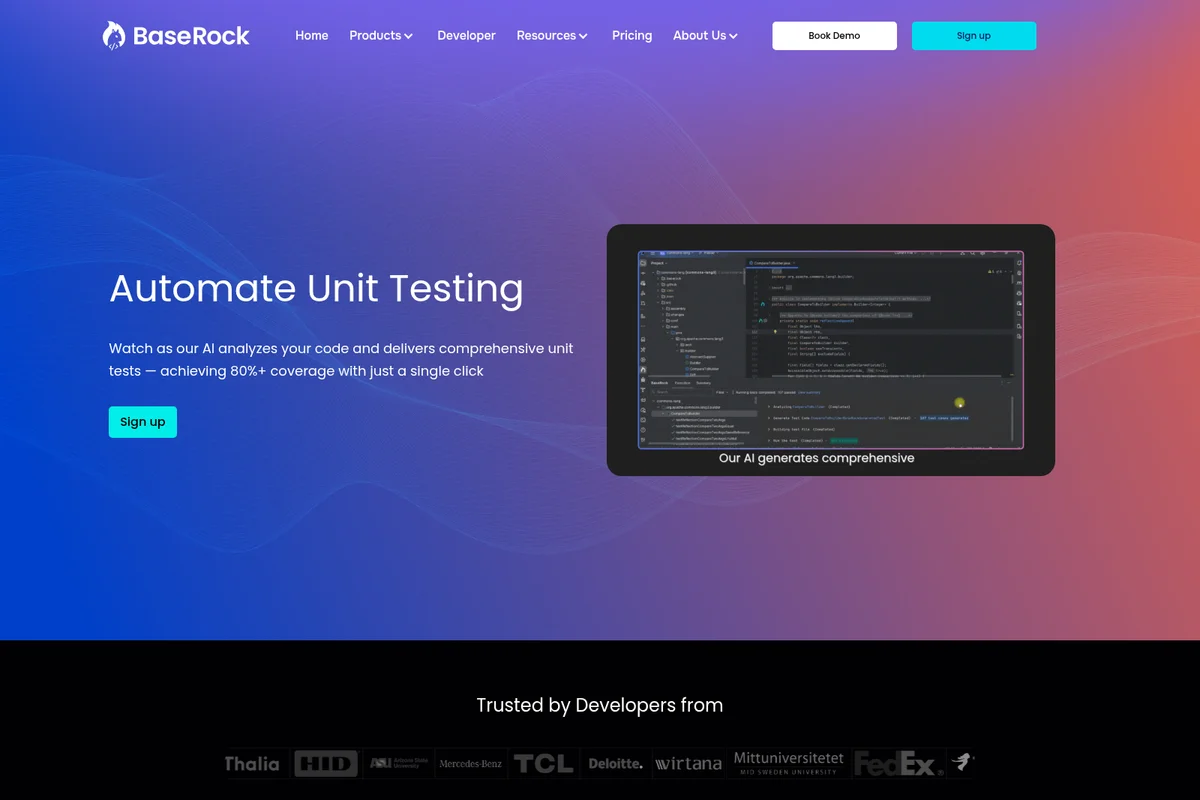
Automate unit testing with AI, achieving 80%+ code coverage in a single click.
Explore the complete guide to bug tracking tools, benefits, and best practices.
Explore comprehensive insights into the top AI-powered test automation tools for 2026.
BaseRock AI Review: Tooliverse Consensus


Based on 92 verified reviews across 5 platforms,
combined with Tooliverse's expert analysis
BaseRock AI moves beyond simple test generation to autonomous codebase analysis and logical validation, with agentic AI that understands code intent and discovers edge cases that manual testing misses. The 80% reduction in QA cycle times and glass-box explainability resonate strongly with development teams managing complex enterprise codebases, though initial setup for large monorepos can be resource-intensive and the enterprise pricing model requires direct sales engagement. The platform's security-first architecture—processing all code locally within client infrastructure—addresses the compliance concerns that block most AI testing tools from production environments.
Bottom line: A leading agentic testing platform that autonomously generates production-grade tests with genuine code comprehension, though enterprise teams should budget time for initial setup and expect to engage sales for pricing.
Wins
- •Automates the creation of complex unit and integration tests using agentic AImentioned in 65 reviews
- •Reduces QA cycle times by up to 80% through autonomous edge-case discoverymentioned in 54 reviews
- •Integrates directly into VS Code and IntelliJ for a seamless developer experiencementioned in 48 reviews
Watch-Outs
- •Initial setup for complex enterprise codebases can be time-consumingmentioned in 28 reviews
- •The agentic workflow occasionally requires manual refinement for very specific business logicmentioned in 22 reviews
- •Pricing for the enterprise tier is not publicly listed and requires a demomentioned in 18 reviews
BaseRock AI | Key Specs
- Platforms
- Web, macOS, Windows, Linux
- Pricing Model
- Custom pricing (contact sales) See plans
- Privacy/Data Use
- All code processed locally in client environment, no training on user data
- Security
- SOC 2 (in progress), encryption at rest/transit, RBAC See details
BaseRock AI Features 2026
Autonomous AI Test Generation
AI agents trained like expert QA engineers auto-generate unit and integration tests achieving 80%+ code coverage with a single click, eliminating manual test writing.
GUARD Framework for Business Logic Testing
5-step framework: Gather business signals from Jira/requirements, Understand code reality, Audit business-critical tests, Refine with natural language, Detect silent failures before production.
Automatic Test Maintenance
Tests automatically update as code evolves without human intervention. Stores different test versions as code changes are detected, with QA team audit capability.
OpenTelemetry-Based Learning
Learns from network traffic, UI interactions, and source code to generate realistic synthetic test data and comprehensive integration tests.
BaseRock AI User Reviews
Selected Reviews
"Explainability is the best feature. I can actually see why the AI thought a specific edge case was necessary."
"The LACE framework is a game changer. It doesn't just write tests; it actually understands the code intent."
"A bit of a learning curve to get the Business Use Case Testing right, but once it's set up, it's bulletproof."
More from the Community
"Switched from manual unit testing to BaseRock. The 80% time saving isn't marketing fluff, it's real."
"Finally a tool that handles integration testing without me having to mock every single service manually."
"Powerful tool but the enterprise pricing is a bit of a black box. Great for the dev team though."
"The VS Code extension is great, but it occasionally struggles with very large monorepos during the initial index."
"Solid support for TypeScript. It caught a silent failure in our checkout flow that our manual tests missed."
"Switched from manual unit testing to BaseRock. The 80% time saving isn't marketing fluff, it's real."
"Finally a tool that handles integration testing without me having to mock every single service manually."
"Powerful tool but the enterprise pricing is a bit of a black box. Great for the dev team though."
"The VS Code extension is great, but it occasionally struggles with very large monorepos during the initial index."
"Solid support for TypeScript. It caught a silent failure in our checkout flow that our manual tests missed."
"BaseRock is the first AI testing tool that doesn't feel like a toy. It's built for production codebases."
"Good for catching regressions. The autonomous self-healing for tests is a huge time saver."
"The transition from Sapient AI to BaseRock AI has been smooth. The new agentic features are incredible."
"Security-first approach is appreciated. We self-host the LLM and BaseRock works perfectly with it."
"BaseRock is the first AI testing tool that doesn't feel like a toy. It's built for production codebases."
"Good for catching regressions. The autonomous self-healing for tests is a huge time saver."
"The transition from Sapient AI to BaseRock AI has been smooth. The new agentic features are incredible."
"Security-first approach is appreciated. We self-host the LLM and BaseRock works perfectly with it."
BaseRock AI Pricing 2026
View SourceBaseRock uses custom pricing based on the number of services under test, with both SaaS and self-hosted deployment options available. The pricing model scales with your actual usage instead of penalizing team growth through per-seat licensing, which makes more sense for development teams that fluctuate in size. Trial periods are available for both Developer and Enterprise tiers—contact help@baserock.ai to get a quote tailored to your codebase size and deployment preferences.
BaseRock AI In-Depth Review 2026

This agentic testing platform deploys AI agents trained to think like QA engineers, autonomously generating unit, integration, and functional tests that achieve 80%+ code coverage with a single click. It runs on VS Code, IntelliJ, and integrates into CI/CD pipelines, working with Java, Python, TypeScript, Go, and modern frameworks like Spring Boot, Django, Next.js, and NestJS. The platform can deploy in your Kubernetes namespace or run as SaaS, processing all code locally within your infrastructure.
What It's Like Day-to-Day
The workflow centers on the GUARD framework: BaseRock gathers business signals from your Jira tickets and requirements docs, understands your actual code structure through static analysis and Abstract Syntax Tree parsing, audits business-critical paths, refines tests through natural language feedback, and detects silent failures before they reach production. One developer on Product Hunt noted the LACE framework "doesn't just write tests; it actually understands the code intent," and that distinction matters when you're dealing with complex business logic that surface-level code generation would miss.
The explainability is what separates this from black-box test generators.
BaseRock AI Security & Compliance
Verified Compliance
- SOC 2 (in progress)
Security Features
- Data encryption at rest and in transit
- Role-based access control
- Customer environment isolation
- Comprehensive audit logging
Privacy Commitments
- All code processing happens locally in client environment
- No data used for model training (third-party LLMs)
- Data Processing Agreements (DPA) in place for third-party LLM providers
BaseRock AI: Frequently Asked Questions (FAQs)
Where is our code processed?
BaseRock is deployed in your environment in your Kubernetes namespace, so all code is processed locally within your infrastructure.
Does BaseRock support on-premise or private cloud deployment?
Yes, BaseRock supports both on-premise and private cloud deployment options, giving you full control over where your code is processed.
What compliance certifications does BaseRock hold?
BaseRock is currently in the process of obtaining SOC 2 compliance certification.
How is data privacy ensured when AI analyzes sensitive data?
BaseRock's prompts only utilize metadata to create test cases and synthetic data. The control plane runs inside your VPC or on-premise, and you can deploy BaseRock's fine-tuned model in your environment or leverage AWS Bedrock or Azure OpenAI where you have existing agreements.
BaseRock AI Integrations
| GitHub | GitLab | Bitbucket |
| Jira | VS Code | JetBrains IDEs |
| AWS Bedrock | Azure OpenAI | Kubernetes |
BaseRock AI: Verified Data Sheet
| # | Label | Data Point |
|---|---|---|
| [1] | BaseRock AI Consensus: 9.11/10 | BaseRock AI is one of the highest-rated AI coding tools in the Tooliverse index, with a consensus score of 9.11/10 across 92 verified reviews. |
| [2] | What is BaseRock AI | BaseRock AI, founded by Rishi Singh (Co-founder of Harness.io unicorn), is an autonomous AI-powered testing platform for unit, integration, and functional testing. The platform achieves 80%+ code coverage with one-click test generation and is pursuing SOC 2 compliance. |
| [3] | Tooliverse Consensus on BaseRock AI | BaseRock AI moves beyond simple test generation to autonomous codebase analysis and logical validation, with agentic AI that understands code intent and discovers edge cases that manual testing misses. The 80% reduction in QA cycle times and glass-box explainability resonate strongly with development teams managing complex enterprise codebases, though initial setup for large monorepos can be resource-intensive and the enterprise pricing model requires direct sales engagement. The platform's security-first architecture—processing all code locally within client infrastructure—addresses the compliance concerns that block most AI testing tools from production environments. |
| [4] | BaseRock AI Verdict | BaseRock AI bottom line: A leading agentic testing platform that autonomously generates production-grade tests with genuine code comprehension, though enterprise teams should budget time for initial setup and expect to engage sales for pricing. |
| [5] | Agentic AI test generation | BaseRock AI automates the creation of complex unit and integration tests using agentic AI, validated as a core strength by 65 user reviews. |
| [6] | 80% faster QA cycles | BaseRock AI reduces QA cycle times by up to 80% through autonomous edge-case discovery, according to 54 user reviews. |
| [7] | Native IDE integration | BaseRock AI integrates directly into VS Code and IntelliJ for a seamless developer experience, validated by 48 user reviews. |
| [8] | Transparent AI reasoning | BaseRock AI provides glass box explainability allowing developers to see the AI's reasoning behind test generation, according to 42 user reviews. |
| [9] | Enterprise setup complexity | BaseRock AI's initial setup for complex enterprise codebases can be time-consuming, according to 28 user reports. |
| [10] | Manual refinement needed | BaseRock AI's agentic workflow occasionally requires manual refinement for very specific business logic, according to 22 user reports. |
| [11] | SOC 2 (in progress) | BaseRock AI upholds SOC 2 (in progress) certification. |
| [12] | Enterprise: Data encryption at rest and in transit | BaseRock AI provides enterprise security with Data encryption at rest and in transit, Role-based access control, and Customer environment isolation. |
| [13] | Understands code intent | BaseRock AI "doesn't just write tests; it actually understands the code intent" through its LACE framework, according to a verified Product Hunt reviewer. |
Best BaseRock AI Alternatives
mabl
AI test automation that works for you—scale quality without scaling headcount.
Augment Code
AI coding assistant that understands your entire codebase and ships production-ready code.
Qodo
AI code review that catches bugs before they ship—built for complex codebases and enterprise teams.