
CodeScene Review 2026 - AI-Ready Code Health
Verified Sep 28, 2026 by Tooliverse Editorial
CodeScene reveals which parts of your codebase are safe for AI agents and which will break them. Its CodeHealth™ metric predicts defects, guards pull requests, and cuts technical debt before it slows delivery.
Stop Letting AI Ruin Your Code: Claude + CodeScene MCP Tutorial
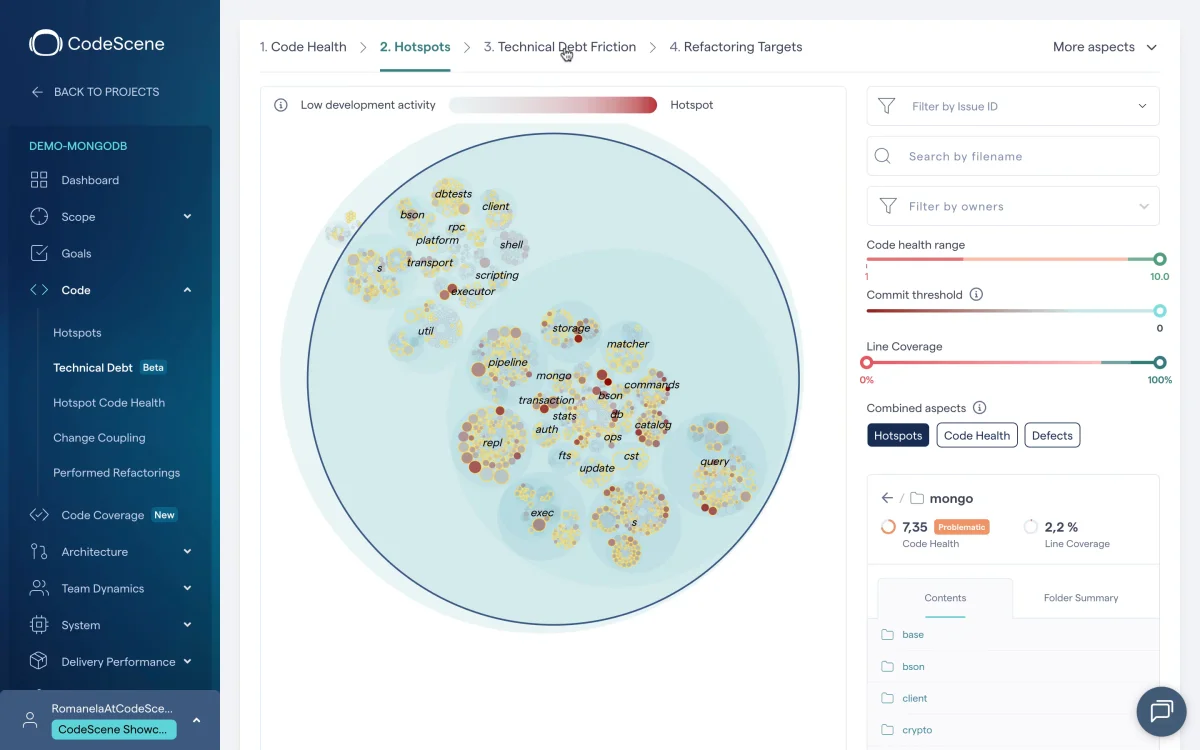
Visually identify code hotspots and problematic areas for focused refactoring.
Improve code quality and reduce technical debt with comprehensive analysis.
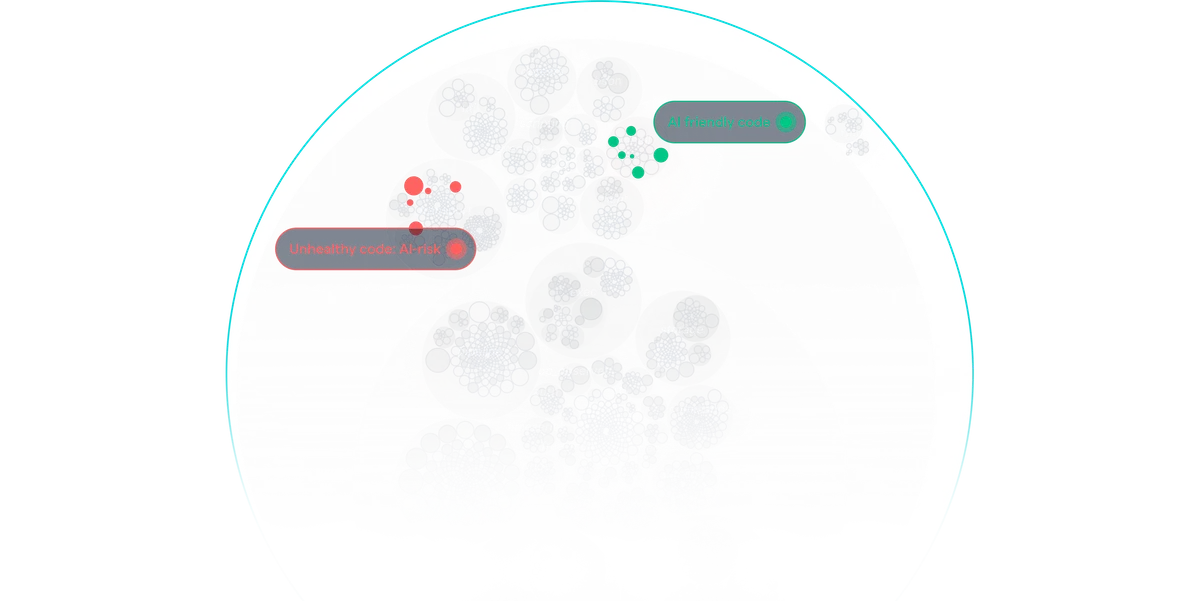
Understand code health and AI readiness across your codebase at a glance.
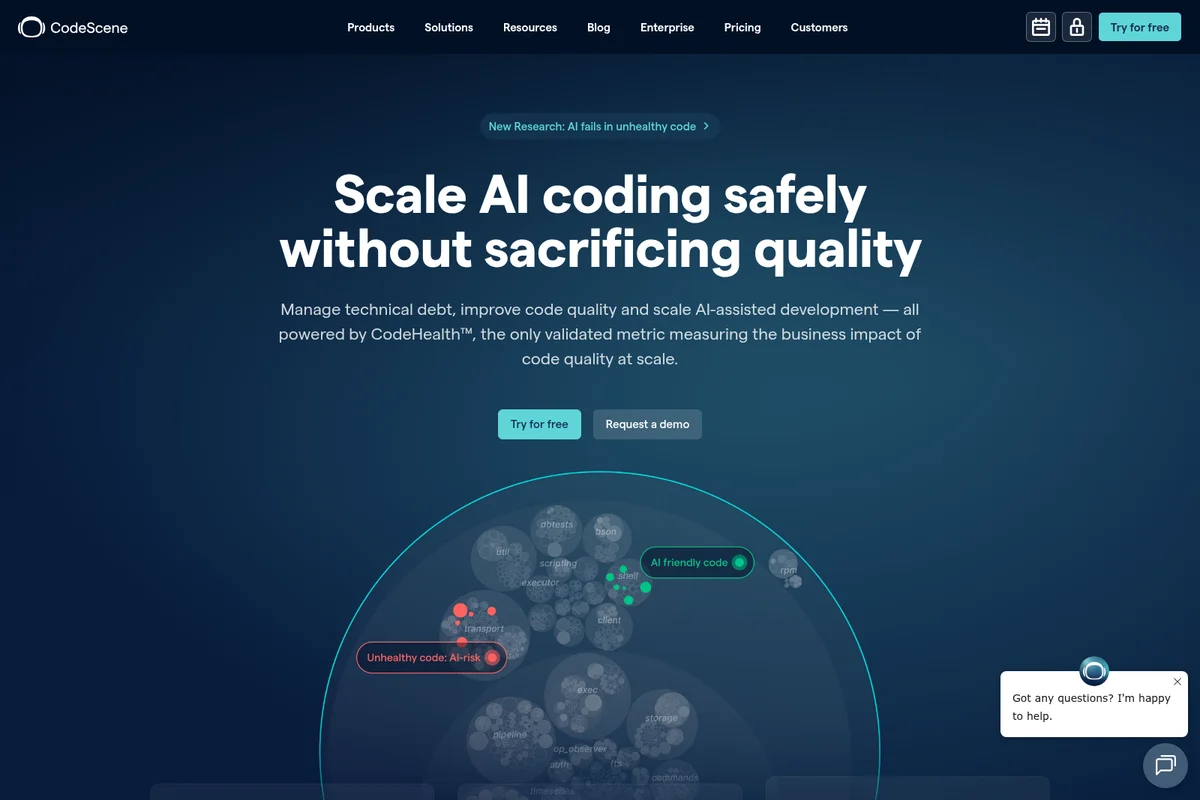
Scale AI coding safely without sacrificing quality, powered by CodeHealth™ metrics.
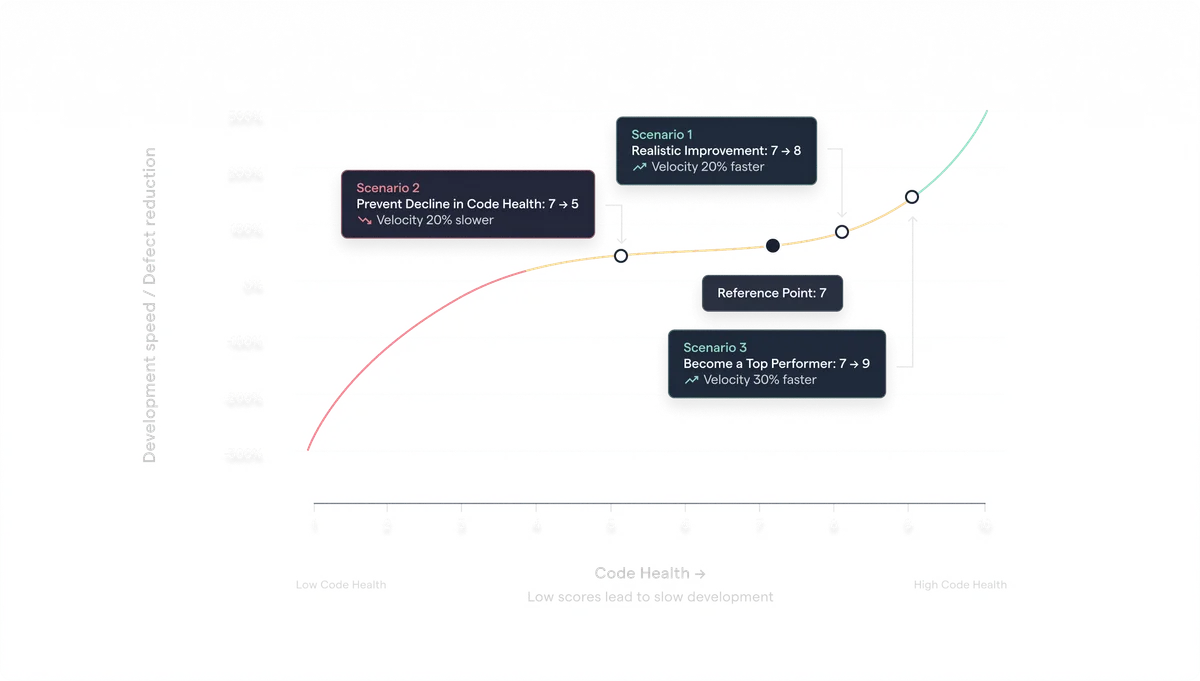
Visualize how code health directly influences development velocity and defect rates.
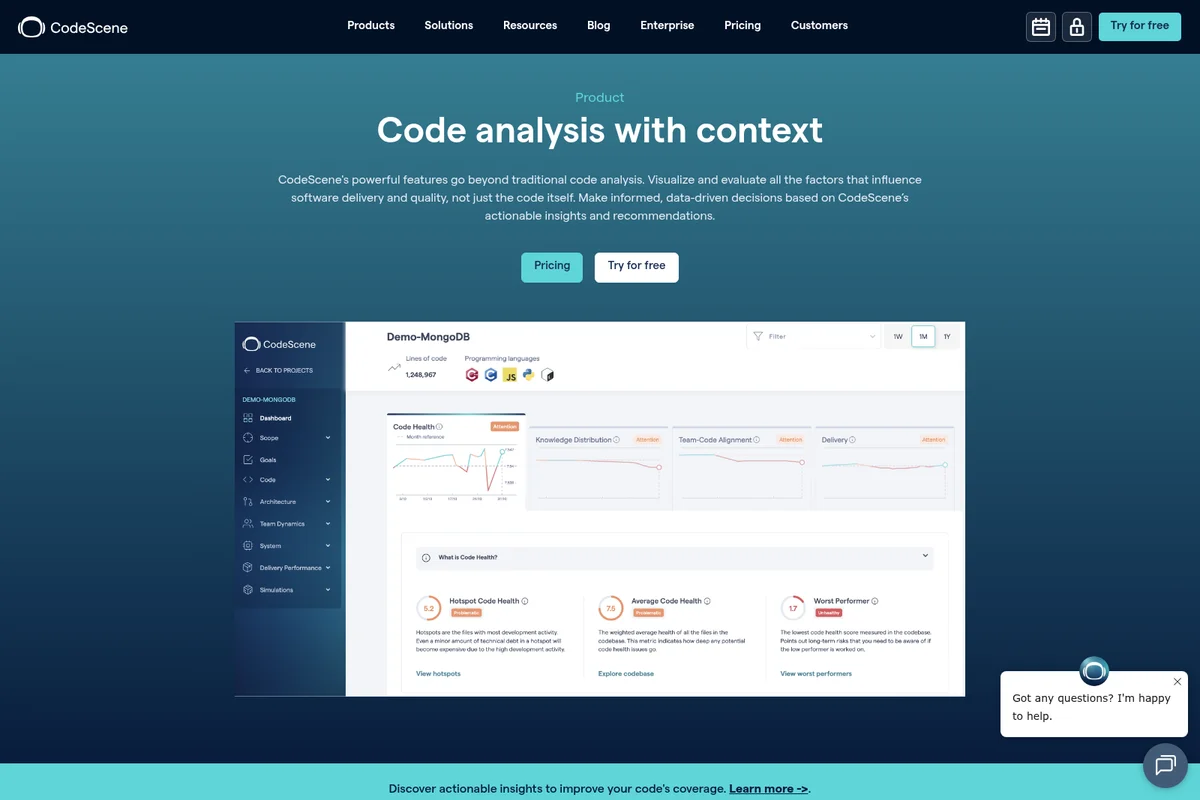
Visualize code health, knowledge distribution, and team alignment with data-driven insights.
CodeScene Review: Tooliverse Consensus


Based on 1k+ verified reviews across 4 platforms,
combined with Tooliverse's expert analysis
CodeScene turns abstract technical debt into a measurable, prioritized business risk, using a deterministic Code Health score that engineering leads and reviewers cite as the reason refactoring decisions stopped being guesswork. Users consistently point to hotspot detection, code health trend tracking, and CI/CD-integrated regression prevention as the standout strengths, while the dashboard's learning curve, per-active-author pricing, and occasional false positives on legacy or auto-generated code remain the clearest friction points for smaller or newer teams.
Bottom line: One of the strongest tools for turning technical debt into prioritized, evidence-backed refactoring decisions, though its dashboard and active-author pricing take real adjustment for smaller teams.
CodeScene | Key Specs
- Platforms
- Web, macOS, Windows, Linux (via IDE/CLI extensions)
- Pricing Model
- Freemium (Free for open-source; $19-29/active-author/mo, Enterprise custom) See plans
- Privacy/Data Use
- GDPR compliant; PR agent doesn't send source code to third parties
- Security
- ISO 27001 certified, SSO, role-based access control See details
Wins
- •Identifies technical debt hotspots with pinpoint accuracy to prioritize refactoringmentioned in 450 reviews
- •Visualizes code health trends over time to track architectural improvements effectivelymentioned in 380 reviews
- •Integrates seamlessly into CI/CD pipelines to prevent quality regressions automaticallymentioned in 310 reviews
Watch-Outs
- •Initial setup and configuration can be complex for large monoreposmentioned in 120 reviews
- •Pricing model can be expensive for smaller teams or early-stage startupsmentioned in 95 reviews
- •The UI has a steep learning curve for non-technical stakeholdersmentioned in 80 reviews
CodeScene Features 2026
CodeHealth™ Metric
A peer-reviewed, research-based score (1-10) aggregated from 25+ maintainability factors, proven to correlate with defect rates and delivery speed. It's the shared quality bar for both human and AI-generated code.
CodeHealth MCP Server
Serves deterministic Code Health context to AI coding agents over the Model Context Protocol, creating a self-correcting loop that safeguards AI-generated code and makes legacy code AI-ready without burning extra tokens.
PR Refactoring Agent
Reviewers trigger guided refactoring directly from a pull request via a /cs-agent comment. The agent analyzes the branch with deterministic Code Health data, performs targeted refactorings, and commits improvements back to the PR for normal review.
AI Risk Assessment
Identifies which parts of a codebase are healthy enough (9.5+ Code Health) for safe AI acceleration versus which carry at least 60% defect risk if AI agents work on them.
CodeScene User Reviews
Selected Reviews
"CodeScene has completely changed how we prioritize refactoring. Instead of guessing where the mess is, we have a heat map showing exactly where the technical debt is slowing us down."
"Love the new PR integration. It catches health regressions before they even hit the main branch. Essential for maintaining quality in fast-moving teams."
"The behavioral code analysis is the killer feature. Seeing how developers interact with the code helps us identify silos we didn't know existed. A bit pricey but worth it for enterprise."
More from the Community
"Powerful tool but the dashboard is overwhelming at first. We spent a lot of time just trying to figure out which metrics actually mattered for our specific workflow."
"Great for visualizing complexity. It helped us justify a major refactor to management by showing the actual cost of the current mess in hours lost."
"Best tool I've used for legacy codebases. It's like having a senior architect constantly auditing your repo."
"The installation was smoother than expected, though the documentation for custom configurations could be more detailed for complex monorepos."
"The insights are great, but we get a lot of noise in our specific microservices architecture. Needs better filtering for small, frequent changes."
"CodeScene's ability to link code health to business impact is unique. It's not just a linter; it's a management tool."
"Solid tool for identifying "God Objects" and high-churn files. The UI is a bit dated but the data is solid."
"We've reduced our bug rate by 30% since we started using CodeScene to guide our code reviews."
"The support team is incredibly responsive and helped us tune the analysis for our specific language mix."
CodeScene Pricing 2026
View SourceStandard at $19 per active author monthly billed annually covers the essentials: Code Health scoring, the MCP Server, and the PR Refactoring Agent across unlimited private repos. Most teams that want portfolio-level visibility and delivery insights should go straight to Pro at $29 per active author monthly billed annually; that's where team-wide reporting actually becomes usable for planning refactor work, not just spotting it.
CodeScene In-Depth Review 2026

CodeScene closes that gap with a deterministic 1-10 Code Health score built from more than 25 maintainability factors, applied consistently across a codebase in 30-plus languages including Python, Java, C++, and TypeScript. It plugs into GitHub, GitLab, Bitbucket, and Azure DevOps, surfaces feedback inside VS Code, JetBrains, and Cursor, and increasingly positions itself as the quality gate for AI-generated code, not just human-written code.
What It's Like Day-to-Day
The daily experience centers on hotspots: files that change often and score poorly on Code Health, ranked so a tech lead can see exactly where refactoring effort will pay off. This is the feature users mention most, and for good reason. One G2 reviewer said CodeScene "completely changed how we prioritize refactoring," replacing guesswork with a heat map that shows precisely where technical debt is dragging velocity down.
What elevates CodeScene above a typical linter is the behavioral analysis layered on top. It tracks how teams actually interact with code over time, exposing knowledge silos, bus-factor risk, and coupling between modules that no static scanner would catch.
CodeScene Security & Compliance
Verified Compliance
- ISO 27001
Security Features
- Single Sign-On (SSO) / Azure Entra ID
- Role-based access control
- On-premise self-managed deployment with offline mode
Privacy Commitments
- GDPR compliant
- PR Refactoring Agent does not send source code to any third party; source code is processed only on the pull request workflow runner
CodeScene: Frequently Asked Questions (FAQs)
Do I have to pay to use CodeScene?
CodeScene is free for open-source projects. Paid plans (Standard and Pro) are available to tailor CodeScene to your needs or analyze private repositories, and a free trial lets you evaluate CodeScene before committing to a plan.
How is the total cost calculated?
CodeScene's license is based on the number of active authors — anyone who has committed code in the past three months across the analyzed codebases, counted only once even across multiple projects. Historic authors (no commits in the last 3 months) are free and don't add to the license fee.
What is included in the free trial?
During the Free Trial, users get access to all features in the plan of their choice (Standard or Pro), with no credit card required.
Is there a limit on the number of active authors per plan?
No, there's no limit on active authors. Total cost scales with how many active authors a team has, but the number of users who can log in and use CodeScene features (like automatic pull request reviews) is unlimited.
CodeScene Integrations
| GitHub | GitLab | Bitbucket |
| Azure DevOps | VS Code | IntelliJ |
| Visual Studio | Cursor | Jira |
| Trello | GitHub Issues | YouTrack |
| Slack | GitHub Copilot | Windsurf |
CodeScene: Verified Data Sheet
| # | Label | Data Point |
|---|---|---|
| [1] | CodeScene Consensus: 9.47/10 | CodeScene is one of the highest-rated AI coding tools in the Tooliverse index, with a consensus score of 9.47/10 across 1,250 verified reviews. |
| [2] | What is CodeScene | CodeScene, developed by CodeScene AB since 2015, is an ISO 27001 certified technical debt and code quality platform built on the peer-reviewed CodeHealth™ metric. It helps engineering teams identify AI-risky code and safeguard AI-generated changes, with pricing starting at $19/active author/month and free access for open-source projects. |
| [3] | Tooliverse Consensus on CodeScene | CodeScene turns abstract technical debt into a measurable, prioritized business risk, using a deterministic Code Health score that engineering leads and reviewers cite as the reason refactoring decisions stopped being guesswork. Users consistently point to hotspot detection, code health trend tracking, and CI/CD-integrated regression prevention as the standout strengths, while the dashboard's learning curve, per-active-author pricing, and occasional false positives on legacy or auto-generated code remain the clearest friction points for smaller or newer teams. |
| [4] | CodeScene Verdict | CodeScene bottom line: One of the strongest tools for turning technical debt into prioritized, evidence-backed refactoring decisions, though its dashboard and active-author pricing take real adjustment for smaller teams. |
| [5] | Open Source (Community): Free | CodeScene's Open Source (Community) tier offers automated code reviews via PR integration and technical debt management through Hotspots, making these AI-powered tools accessible at no cost. |
| [6] | Reveals team coupling and knowledge silos | CodeScene surfaces team coupling and knowledge distribution silos through behavioral code analysis, a strength noted in 240 user reviews for revealing bus-factor risk. |
| [7] | Cuts manual code review time | CodeScene reduces time spent on manual code reviews by highlighting the most critical areas of a codebase first, a time-saving benefit reported in 190 user reviews. |
| [8] | Pro: $29/user/mo (annual) | CodeScene's Pro plan, from CodeScene AB, adds Software Portfolio overview for $29/user/month billed annually, significantly expanding on the free tier's capabilities. |
| [9] | Pinpoints technical debt hotspots | CodeScene identifies technical debt hotspots with pinpoint accuracy, a capability confirmed by 450 user reviews as a primary reason teams prioritize refactoring work more effectively. |
| [10] | Tracks code health trends over time | CodeScene visualizes code health trends over time, helping engineering teams track architectural improvements, a benefit cited in 380 user reviews. |
| [11] | Complex setup for large monorepos | CodeScene's initial setup and configuration can be complex for large monorepos, a challenge reported in 120 user reviews, particularly around documenting custom configurations. |
| [12] | UI has learning curve for non-technical users | CodeScene's dashboard presents a steep learning curve for non-technical stakeholders, an adoption hurdle noted in 80 user reviews. |
| [13] | Privacy: GDPR compliant | CodeScene privacy protections include GDPR compliant and PR Refactoring Agent does not send source code to any third party; source code is processed only on the pull request workflow runner. |
| [14] | Enterprise: Single Sign-On (SSO) / Azure Entra ID | CodeScene provides enterprise security with Single Sign-On (SSO) / Azure Entra ID, Role-based access control, and On-premise self-managed deployment with offline mode. |
| [15] | Heat map replaces refactoring guesswork | CodeScene turns technical debt into a visual heat map, letting engineering teams prioritize refactoring by evidence instead of guesswork, according to a verified G2 reviewer who said it "completely changed how we prioritize refactoring." |
Best CodeScene Alternatives

SonarQube
Catch bugs and vulnerabilities in AI-generated and human code before they ever reach production.

Qodo
Ship trusted code at agent speed with AI review that knows your whole codebase.
Greptile
AI code review that knows your whole codebase and catches the bugs humans miss.